
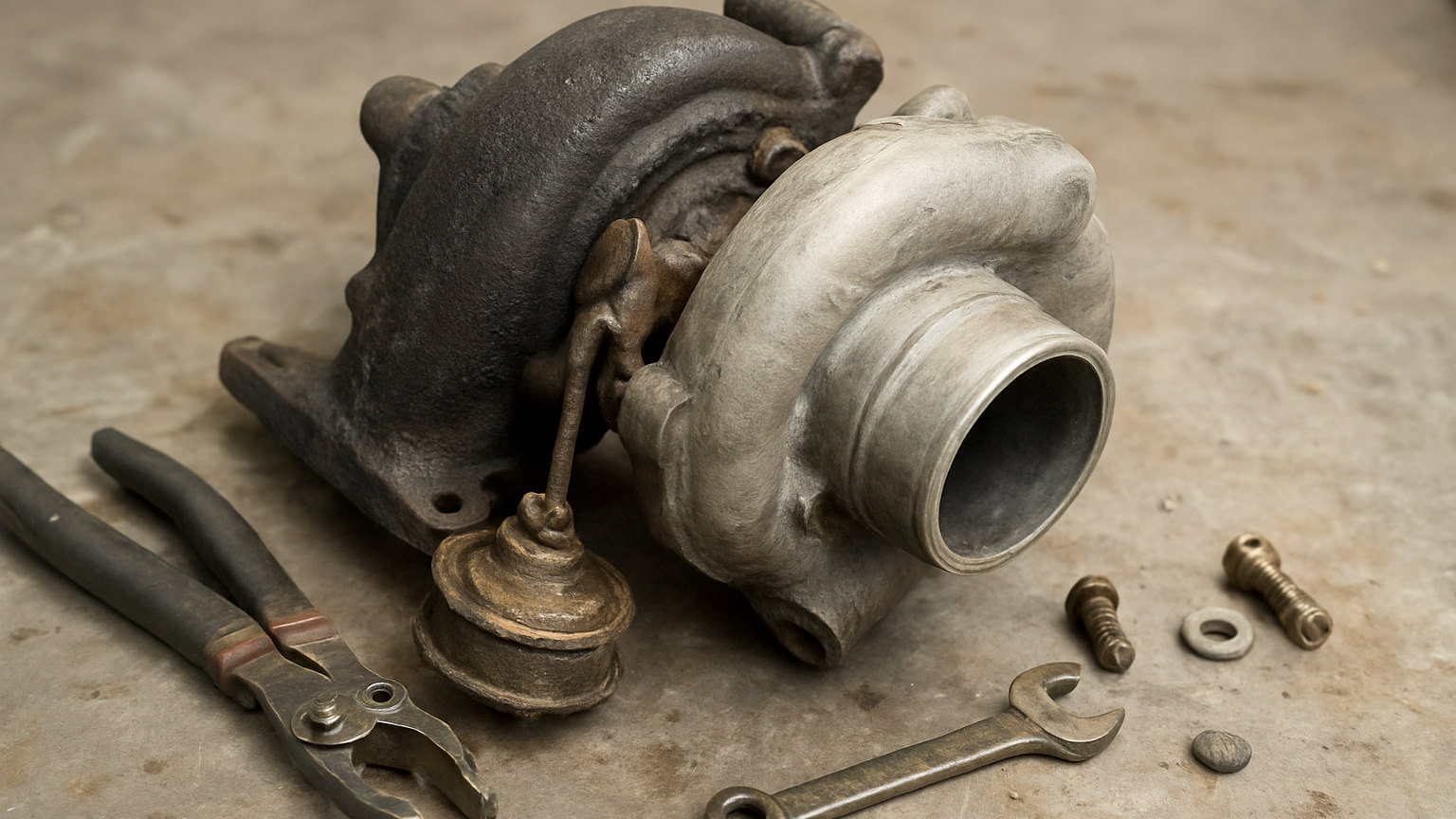
The sensation is distinctive. The car pulls away normally, feels entirely ordinary at low revs, and then simply fails to deliver the surge that should arrive as the turbo spools up. Instead of building, it flattens out. That pattern points firmly at the boost system rather than the engine itself, and the good news is that the cheapest possible causes are also among the most common.
How does a turbo actually make power?
Exhaust gas spins a turbine, which drives a compressor on the same shaft, which forces more air into the engine than it could draw in on its own. More air allows more fuel, and more fuel makes more power. That pressurised air travels from the turbo through pipework to an intercooler and then to the inlet manifold, and every joint along that route is a place where boost can escape before it reaches the engine.
What is the most common cause?
A leak in the boost pipework, and specifically a split hose or a clamp that has worked loose. These pipes flex with engine movement, get hot and cold repeatedly, and eventually crack, usually at a bend or where the rubber meets a metal section. The symptoms are a car that feels flat under acceleration, often a hissing or whooshing noise when you accelerate hard, and frequently limp mode as the management detects that boost pressure is nowhere near the target.
Because the escaping air carries a fine oil mist, leaks often leave a visible wet or dirty patch around the split. Inspecting the intercooler pipework from the turbo outlet through to the inlet manifold, feeling along each hose for cracks that open when flexed, finds a great many of these faults without any equipment at all.
What do sticking vanes do?
Most modern diesel turbos are variable geometry, meaning small vanes inside the turbine housing change angle to control how hard the turbo works at different engine speeds. Those vanes run in a hot sooty environment and can seize with carbon deposits, particularly on cars used for short journeys. When they stick, the turbo either fails to build boost at all or builds too much and triggers an overboost fault. The car frequently goes into limp mode, and the fault sometimes clears on a restart and returns under load.
Could it be the actuator rather than the turbo?
Yes, and this distinction matters financially. The vanes or wastegate are moved by an actuator, either a vacuum diaphragm or an electric motor, and the actuator can fail or lose its vacuum supply while the turbo itself is perfectly healthy. A perished vacuum hose, a failed vacuum pump or a leaking solenoid will produce identical symptoms to a failed turbo at a fraction of the cost. This is why a proper diagnosis using live data matters before a turbo is condemned.
What suggests the turbo itself has failed?
Noise and oil. A harsh siren-like screech, a rumbling or grinding, blue smoke from the exhaust, high oil consumption or oil pooling in the intercooler pipework all suggest the bearings and seals have worn. A mechanic can remove an intake pipe and check the compressor wheel for play and for contact marks on the housing. A turbo with excessive shaft movement or damaged blades needs replacing, and it should be done promptly because debris entering the engine turns one repair into two.
What should you check first?
Get the fault codes read, since underboost and overboost codes point in useful directions, then inspect every boost pipe and clamp between the turbo and the manifold. Those two steps cost very little and resolve a substantial proportion of cases. Only when the pipework is confirmed sound and the actuator has been checked is it reasonable to start discussing the turbocharger itself.
Turbochargers are expensive enough that a second opinion is worth having before one is replaced, particularly if the diagnosis rested on a fault code alone rather than on measured boost pressure and a physical inspection of the shaft.


