
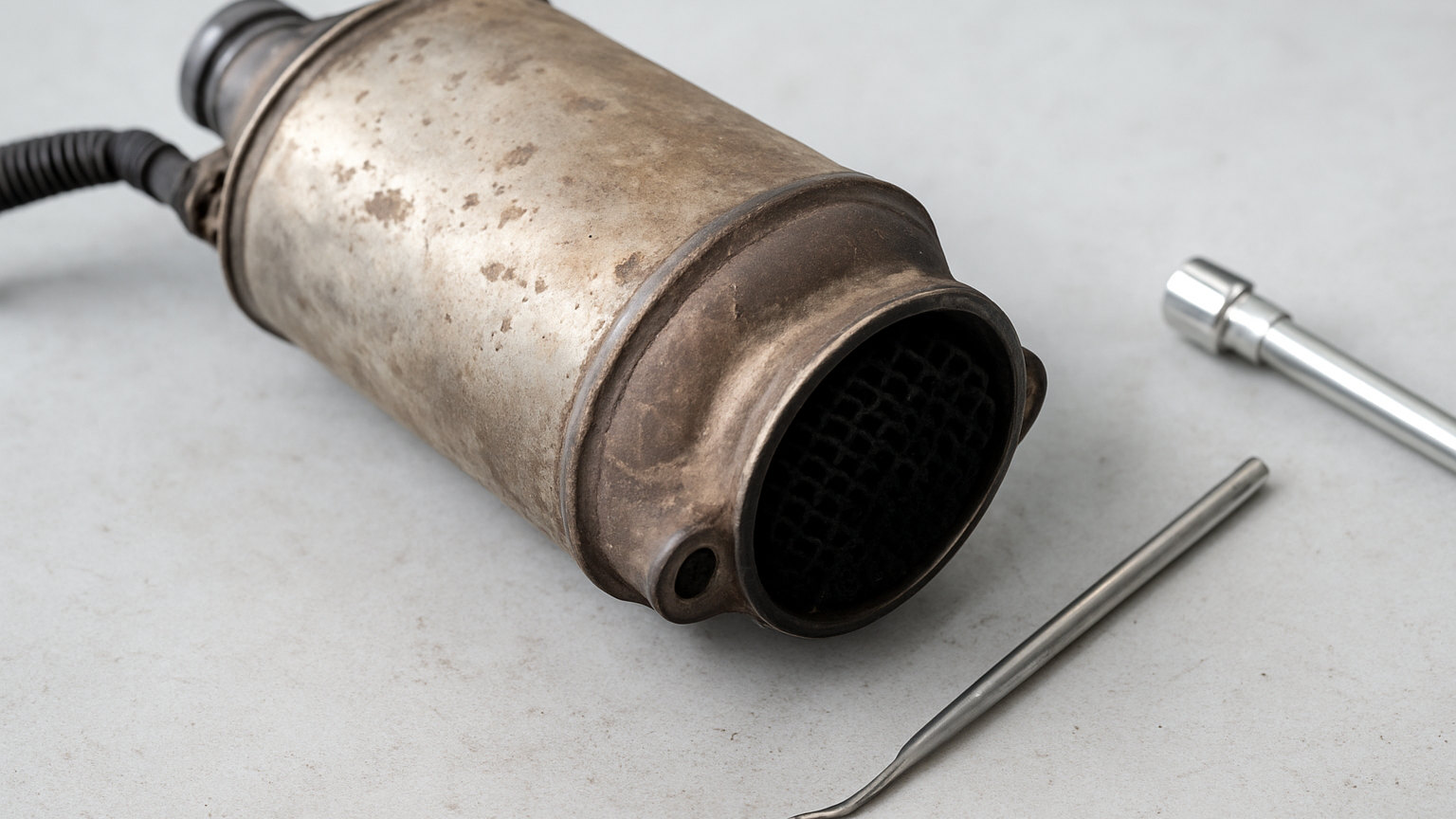
The diesel particulate filter traps soot from the exhaust and periodically burns it off in a process called regeneration, which needs high exhaust temperatures sustained for long enough to work. Cars that spend their lives on short cold journeys never reach those conditions, so the soot accumulates instead of burning. The result is one of the most common and most avoidable causes of power loss on modern diesels.
What are the early warning signs?
A dedicated DPF warning light, usually shaped like a box with dots inside it, is the clearest signal and means a regeneration is needed rather than that the filter has failed. Before or alongside it you may notice reduced fuel economy, a cooling fan running more than usual, an idle that is slightly higher than normal, and a smell that is hotter and sharper than the everyday exhaust smell. Some cars display a message asking you to drive at sustained speed.
What happens if the warning is ignored?
Soot continues to build until the restriction becomes severe, at which point the car enters limp mode with sharply reduced power and the engine management light appears. At that stage a passive regeneration on a motorway run will usually no longer work, and the filter needs a forced regeneration carried out by a garage using diagnostic equipment. Beyond that point, the options are chemical cleaning, removal and off-car cleaning, or replacement, and the costs rise steeply through that list.
Why do regenerations fail?
Most commonly because the journey ends too soon. A regeneration cycle typically takes between ten and twenty minutes of sustained driving at reasonable speed and load, and switching the engine off partway through leaves the process incomplete and the filter partially loaded. Repeated interrupted cycles are worse than none at all, because each one adds unburnt fuel to the oil. That is why a DPF warning light should be treated as an instruction to take a proper drive rather than something to deal with next week.
How should you carry out a regeneration drive?
Take the car onto a dual carriageway or motorway once it is fully warm, hold a steady speed of around fifty to seventy in a gear that keeps the revs somewhere above two thousand, and maintain that for at least twenty minutes without stopping. The exhaust needs sustained heat rather than brief bursts of acceleration. If the light goes out during the drive, the cycle has completed. If it stays on after two attempts, the filter needs attention rather than more driving.
What causes premature blocking beyond short journeys?
Anything that increases soot production or prevents regeneration. Failing injectors that deliver too much fuel, a sticking EGR valve recirculating excess exhaust gas, a turbo leaking oil into the exhaust, a faulty differential pressure sensor giving false readings, and using the wrong engine oil all contribute. Low ash oil meeting the correct specification matters here, because ordinary oil leaves ash deposits that cannot be burned off at all and permanently reduce filter capacity.
Is removing the filter an option?
No. Removing a DPF makes the car fail its MOT, since visual inspection for the filter is part of the test, and using a vehicle on the road with it removed is an offence. It also invalidates insurance in many cases. Cleaning and replacement are legitimate routes, and a proper off-car clean is considerably cheaper than a new filter, so it is worth asking whether that has been considered before agreeing to a replacement.
Is a diesel the right car for you?
If your driving is mostly short trips in town, honestly probably not. The filter is only one of several systems on a modern diesel that depend on regular long hot runs, and the same journeys that block a DPF also foul the EGR valve and shorten oil life. Recognising that pattern early saves a great deal of money, and a car chosen to suit the driving is cheaper than one being repeatedly repaired for doing the wrong sort of miles.


