
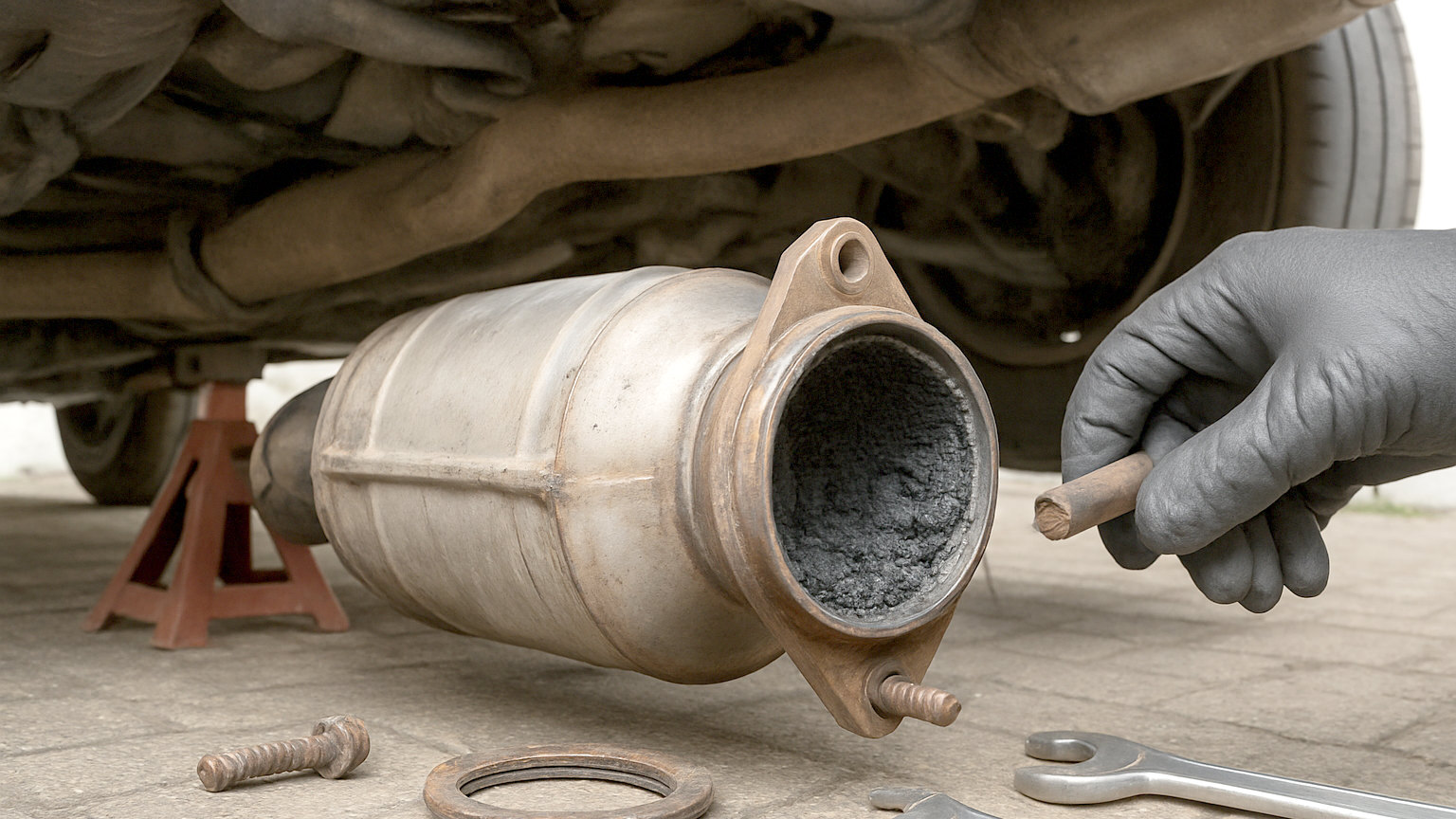
An engine is an air pump, and a pump that cannot exhaust freely cannot draw in freely either. When a catalytic converter becomes restricted, the exhaust gas has nowhere to go and the engine effectively has to work against itself. The resulting symptoms are distinctive enough to recognise, and they are frequently misread as fuel starvation because both produce a car that runs out of breath.
What does it feel like from the driving seat?
The classic description is a car that pulls reasonably from a standstill and then meets an invisible barrier, usually somewhere in the middle of the rev range, beyond which no amount of throttle makes any difference. It gets worse the longer you hold full throttle, because back pressure builds, and it may improve after the car has been left to idle or has coasted for a while. Top speed drops noticeably, hills become difficult, and fuel consumption rises.
What else gives it away?
Heat is a strong clue. A converter working against a blockage runs extremely hot, sometimes hot enough to discolour the metal or to be visible as a glow underneath the car in the dark. There is often a distinctive smell of sulphur or rotten eggs. On a car with a badly broken down internal substrate, you may hear a rattle from underneath when the engine is switched off or when the exhaust is tapped, as fragments of the honeycomb move around inside.
Why do catalytic converters block?
Rarely on their own, which is the important point. The substrate melts or clogs because something upstream has been feeding it more than it can handle. A long running misfire sends unburnt fuel into the converter where it ignites, and the resulting temperatures destroy the honeycomb. An engine burning oil coats the substrate. A rich running condition caused by a failed sensor does the same. Replacing a converter without finding what killed it usually means killing the replacement too.
How is a blockage confirmed?
A garage can measure exhaust back pressure directly, by fitting a gauge in place of an oxygen sensor and reading the pressure at raised revs. A vacuum gauge on the inlet manifold shows a characteristic falling reading when the engine is held at steady revs with a restricted exhaust. Modern cars also monitor the converter efficiency using front and rear oxygen sensors, so a stored code relating to catalyst efficiency is worth reading, though that code sometimes reflects a failing sensor rather than a failing converter.
Can a blocked converter be cleaned?
Sometimes, if the substrate is intact and the deposits are chemical rather than physical. Cleaning additives run through a full tank followed by a sustained motorway drive occasionally help mild cases. Where the honeycomb has melted or collapsed, no chemical will restore it and replacement is the only option. Aftermarket converters vary considerably in quality, and one that does not meet the correct specification for the vehicle will trigger efficiency fault codes and can fail an emissions test.
What does this mean for the MOT?
A failing converter shows up as excessive emissions at the test, and a rattling or physically damaged one is a failure in its own right. It is also worth knowing that catalytic converters are stolen for their metal content, particularly from certain models, and a car that has suddenly become extremely loud has probably lost one rather than blocked one. That is a different problem with a similar starting point.
What should you do first?
Have the fault codes read, and pay particular attention to any history of misfires or rich running, because those are the causes rather than the consequences. Then ask for a back pressure test rather than accepting a diagnosis based on symptoms alone. Fixing whatever damaged the converter first is not optional, since a new one fitted to an engine that is still misfiring will be ruined in a matter of months.


