
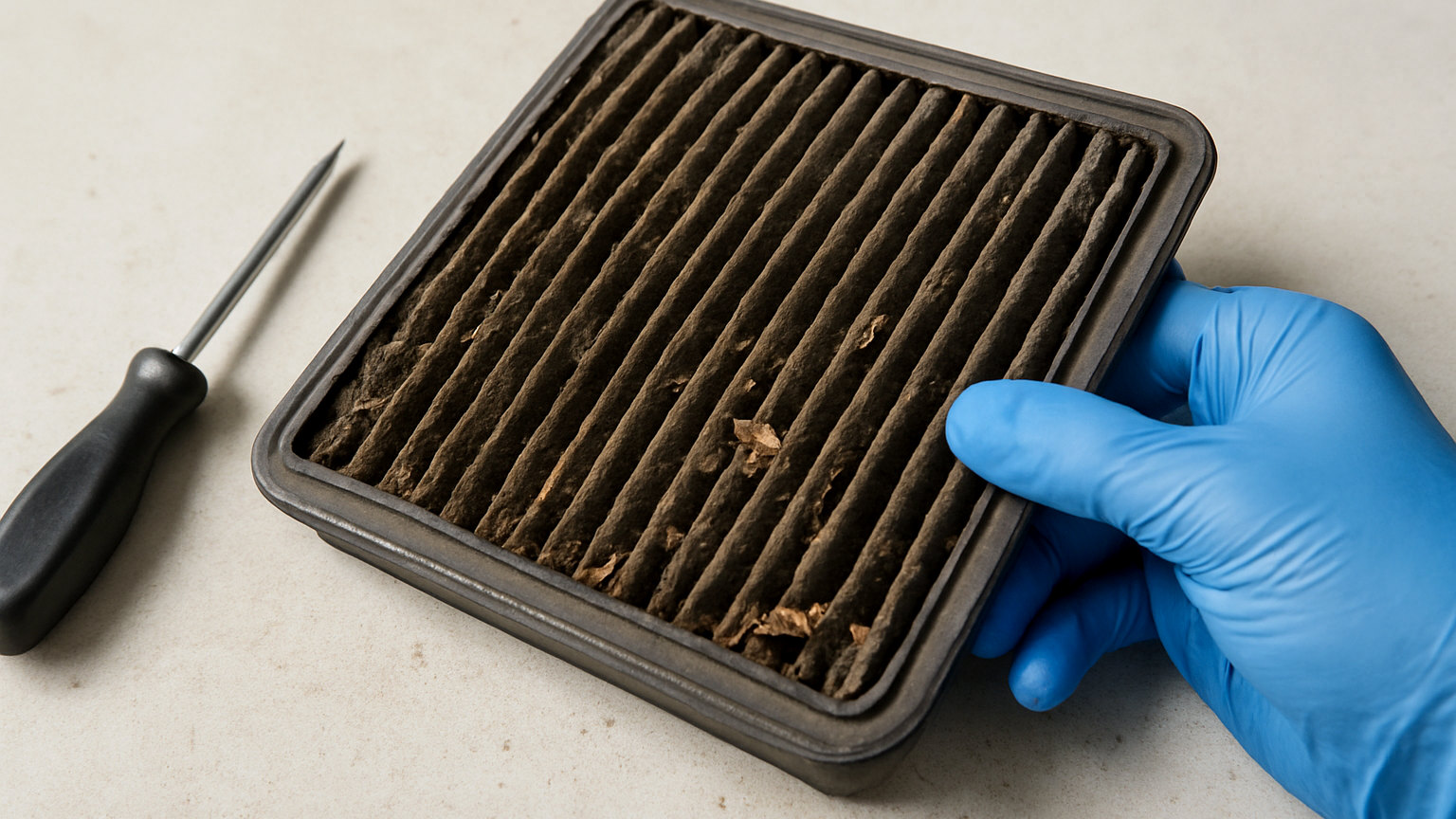
The air filter is the cheapest and most accessible service item on a car, which is exactly why it gets blamed for problems it did not cause and ignored when it genuinely is at fault. The honest answer is that a moderately dirty filter makes very little difference in ordinary driving, and a genuinely blocked one absolutely does restrict a hard working engine. The distinction lies in how much air the engine is trying to draw.
Why does it matter more under load?
At light throttle the engine is drawing a small fraction of the air it can consume, and the filter is nowhere near its flow limit even when dirty. At full throttle the demand can be ten times higher, and a restriction that was irrelevant becomes a bottleneck. This is why a blocked filter produces a car that seems perfectly normal around town and disappointing on a motorway slip road, which is a pattern shared with several other faults and therefore not diagnostic on its own.
What are the symptoms?
Reduced power under hard acceleration, slightly worse fuel economy, occasionally a richer running condition that produces black smoke on older engines, and sometimes a deeper intake noise as the engine works harder to draw air. On modern cars the management compensates using the airflow sensor, so the fuelling stays broadly correct and the main symptom is simply less power available. Severe blockage can affect idle quality and, in extreme cases, trigger fault codes.
How do you check it?
The airbox is usually a black plastic box near the front of the engine bay, held together by clips or a few screws, and opening it takes a couple of minutes on most cars. Lift the filter out and hold it up to a bright light. A filter you cannot see any light through is finished. A filter with a light covering of dust on the outside and clean pleats is fine. Look also for leaves, seeds and insects packed into the pleats, which is common on cars parked under trees.
How often should it be replaced?
The service schedule usually specifies an interval, but the honest answer depends heavily on conditions. Cars driven on dusty rural roads, unsurfaced tracks or in heavy urban traffic need filters more often than the book suggests, and a car used mainly on clean motorways less. Checking it at every oil change and replacing it when it looks bad, rather than strictly by mileage, is a more sensible approach and costs nothing to do.
Should you clean rather than replace it?
Standard paper filters should not be cleaned. Blowing compressed air through one from the outside drives dirt deeper into the medium, and from the inside it can tear the paper, which then lets unfiltered air into the engine. Since a replacement filter is one of the cheapest parts available, cleaning a paper element is a false economy. Reusable cotton filters are designed to be washed and re-oiled, following the manufacturer instructions exactly.
Are performance filters worth fitting?
On a standard engine, rarely. The gains on an unmodified car are small enough to be difficult to measure, and over-oiled cotton filters are a well known cause of contaminated mass airflow sensors, which causes hesitation and poor economy. An open cone filter drawing hot air from the engine bay can genuinely reduce power on a warm day. A clean standard filter of good quality is the sensible choice for almost every road car.
What else should you check while you are in there?
Make sure the airbox seals properly when closed and that all the clips are engaged, since unfiltered air bypassing the filter is far worse than a dirty filter. Check the intake ducting for splits, particularly the flexible section between the airbox and the throttle body, because a crack there lets in unmeasured air and causes rough running. Both take seconds to inspect while the box is open and both cause problems that are much harder to diagnose later.


