
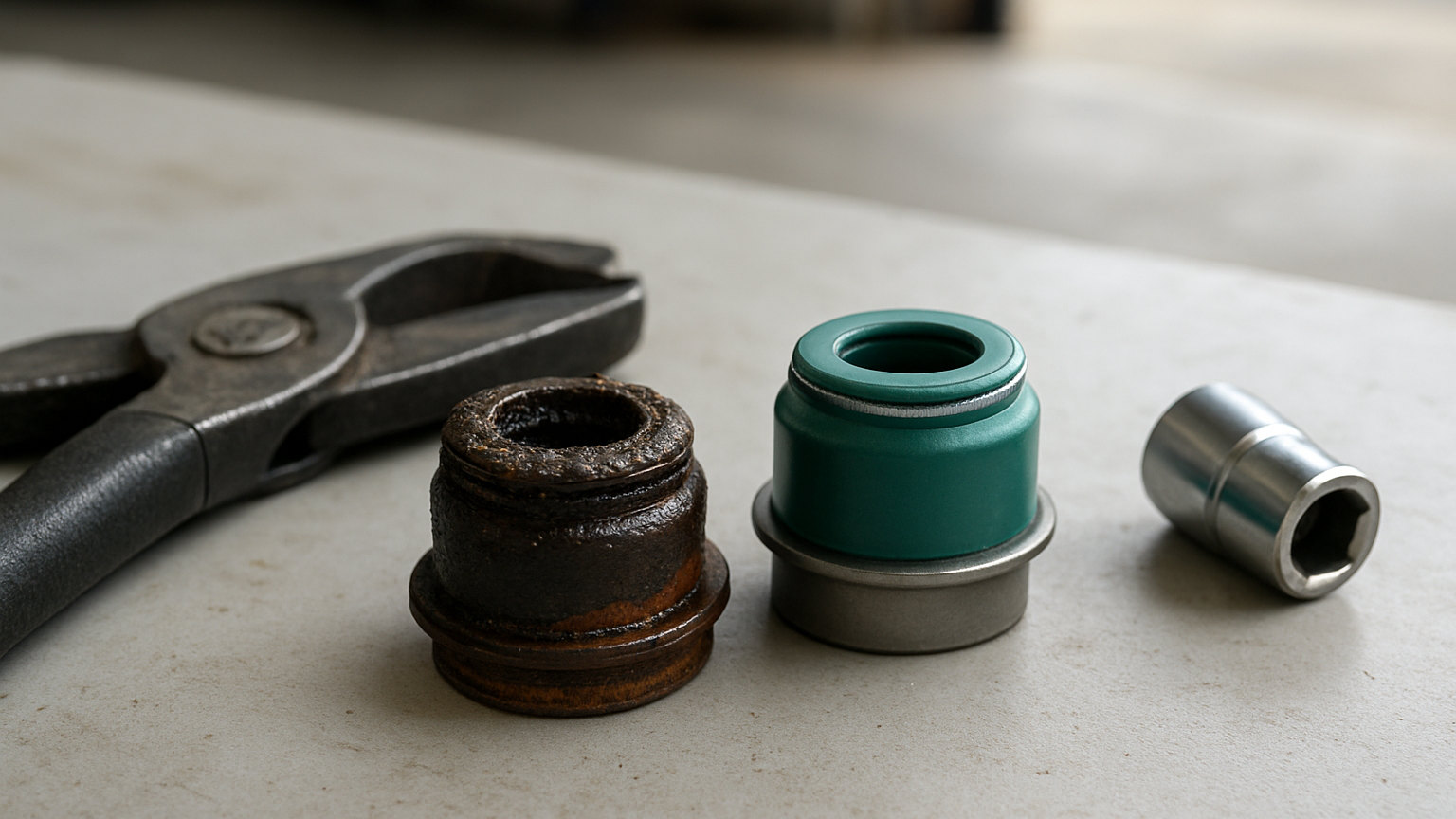
Smoke on the overrun is one of the most specific symptoms in the whole field of exhaust diagnosis. It appears when you lift off the accelerator after a period of higher revs, typically noticed as a blue cloud in the mirror when slowing for a roundabout or coming down a long hill. It is not general oil burning, and it points at one area of the engine with unusual precision.
Why does lifting off cause smoke?
When you close the throttle while the engine is still turning quickly, the engine is trying to draw air past a nearly closed plate, which creates a very strong vacuum in the inlet manifold and the cylinder head. That vacuum acts on everything connected to it, including the valve guides. If the valve stem seals have hardened and no longer seal properly, oil from the cylinder head is pulled down past the stems and into the combustion chamber, where it burns when the throttle opens again.
What does this tell you about the engine?
That the problem is in the cylinder head rather than the bottom end, which is generally good news. Worn valve stem seals are a normal consequence of age and heat cycling and can occur on an engine whose bores, rings and bearings are in excellent condition. The distinction matters because piston ring wear means a rebuild, whereas seals can often be replaced with the head still on the car, using compressed air to hold each valve closed while the springs are removed.
How does it differ from other oil smoke?
Smoke under acceleration points at rings, since that is when cylinder pressure differences are greatest. Smoke on startup points at seals allowing oil to drain overnight. Smoke on the overrun points at seals again, through vacuum rather than gravity. A car that smokes on startup and on the overrun but stays clean under hard acceleration has a fairly clear signature, and most engines showing that pattern have seals that have simply hardened with age.
Could it be the turbo instead?
It can, and on a turbo car this is worth checking first. When you lift off, the turbo continues spinning while the pressure in the intake falls, and a unit with worn seals will pass oil under those conditions. The clues are oil in the intercooler pipework, a whine that has changed character, and boost that is lower than it should be. Because turbo failure can send debris into the engine, ruling it in or out early is sensible.
What about worn valve guides?
The seals sit on the guides, and on high mileage engines the guides themselves wear oval, at which point no new seal will fully solve the problem. A garage can assess guide wear by measuring the side to side movement of the valve stem once the head is accessible. Where guides are worn, the proper repair involves reaming and fitting new guides, which turns a moderate job into a cylinder head overhaul.
How serious is it?
Usually less serious than it looks. Oil consumption from seals alone tends to be moderate, and many cars run for years in this condition provided the level is checked and maintained. The two reasons to act are an emissions test, since visible smoke can fail an MOT, and the fact that oil passing into the exhaust gradually poisons the catalytic converter. If the smoke is heavy enough to be embarrassing at traffic lights, it is heavy enough to matter.
What should you do about it?
Monitor oil consumption properly by writing down how much you add and over what mileage. Have a compression test done, since a healthy result confirms the bottom end is sound and makes seal replacement a sensible investment. Avoid switching to a much thicker oil in the hope of reducing the smoke, since it slows cold circulation and causes wear elsewhere while only masking the symptom.


