
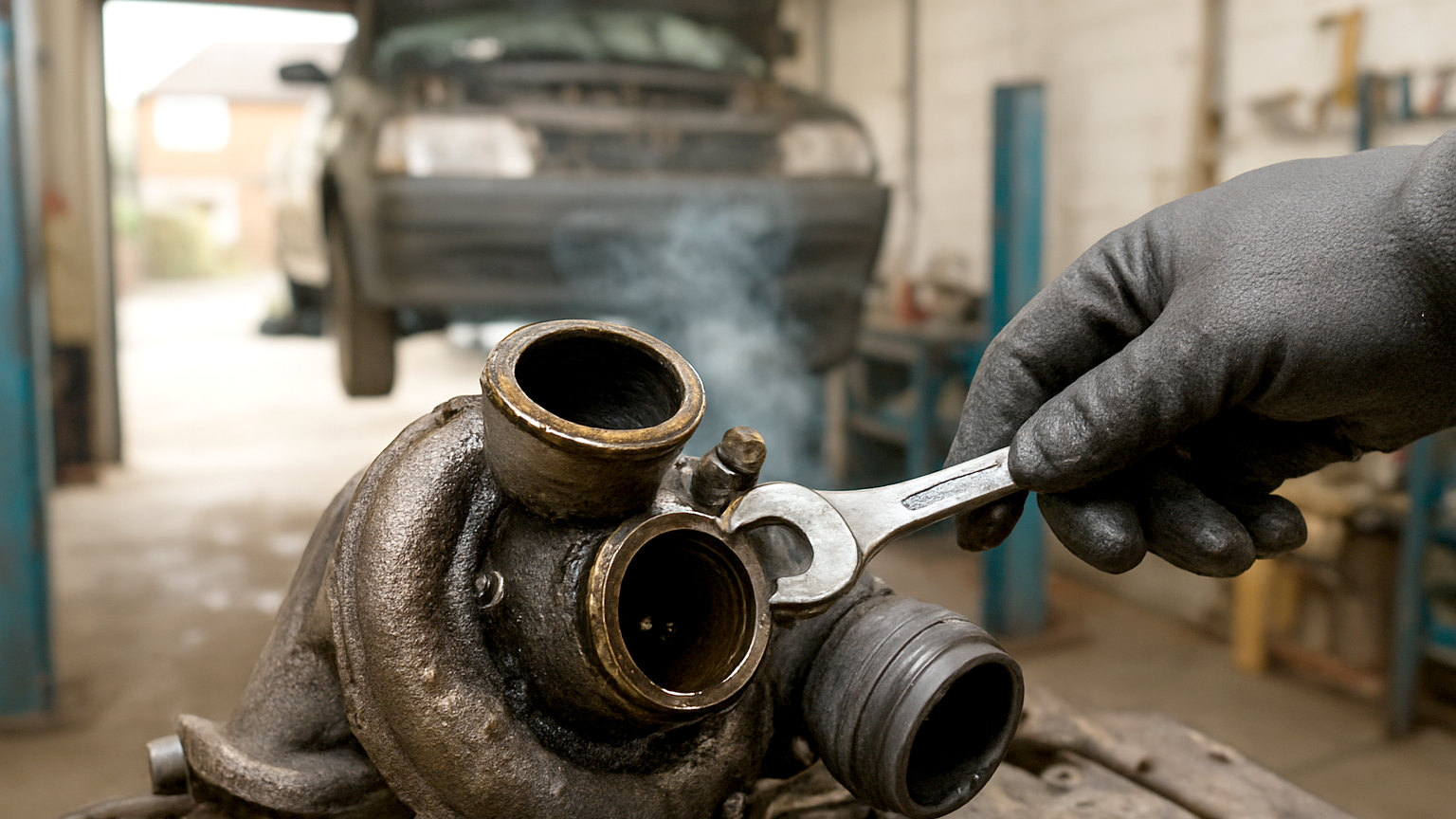
A turbocharger sits in two places at once, with its turbine in the exhaust stream and its compressor in the intake, and it is lubricated by engine oil fed under pressure to bearings spinning at extraordinary speeds. When the seals or bearings fail, oil escapes into both sides simultaneously, which is why turbo failure produces such dramatic smoke and why it can escalate into something more serious than a component replacement.
What happens when the seals fail?
Oil that should stay in the bearing housing passes into the compressor side, where it is blown into the intake and drawn into the cylinders, and into the turbine side, where it goes straight into the exhaust. The result is heavy blue smoke, usually worst under acceleration and after periods of idling. Oil pools visibly in the intercooler and its pipework, which is one of the most reliable confirmations available without dismantling anything.
What is a diesel runaway?
This is the rare but genuinely dangerous outcome, and it is worth understanding. A diesel engine ignites whatever combustible material reaches its cylinders, and it does not need the fuel injectors to do so. If enough engine oil enters the intake through a failed turbo, the engine can begin running on its own lubricating oil, which the driver cannot control by lifting off or switching off the ignition. The engine revs uncontrollably, produces enormous quantities of smoke, and usually destroys itself.
What do you do if that happens?
Stop the car safely, get everyone out and away from it, and do not attempt to approach the engine bay, because a runaway engine can throw components. Some drivers are advised to stall the engine by selecting a high gear and releasing the clutch while braking hard, which works if you have the presence of mind and the situation allows, but personal safety comes first. This scenario is rare and it is worth knowing simply because the correct response is not obvious.
Why did the turbo fail in the first place?
Nearly always oil supply. Blocked or coked oil feed pipes, extended oil change intervals, low oil level, the wrong oil specification, or shutting a hot engine down immediately after hard driving all starve or bake the bearings. Debris passing through the compressor from a failed air filter or a loose intake component causes mechanical damage. Understanding which applies matters, because fitting a new turbo without addressing the cause simply repeats the failure.
What must be done alongside the turbo?
The oil feed and return pipes should be replaced or thoroughly cleaned, since coked deposits inside them are frequently the original cause. The intercooler must be flushed or replaced, because oil sitting in it will be drawn into the engine after the repair and produce smoke that looks exactly like a second failure. The oil and filter should be changed, and the intake system checked for debris from the failed compressor wheel.
Can debris damage the engine?
It can. Fragments of a disintegrated compressor wheel travel straight into the inlet manifold and then into the cylinders, where they can damage pistons, valves and bores. This is the main reason a suspected turbo failure should not be driven on while you save up for the repair. If the turbo has clearly broken up rather than simply leaked, the intake should be inspected before the engine is run again.
How do you make the replacement last?
Prime the new turbo with oil before starting, follow whatever bedding in procedure the supplier specifies, and change the oil at shorter intervals than the manufacturer schedule if the car does mostly short journeys. Allow a minute of gentle running from cold before working the engine hard, and a short idle after a hard drive so oil can carry heat away rather than baking in the bearing housing. Most premature turbo failures are oil failures rather than manufacturing ones, and those habits address the cause directly rather than hoping the replacement is simply a better part.


