
Exhaust smoke can fail an MOT in two separate ways, and knowing the difference explains why one visibly smoky car passes while another is refused. There is a metered emissions test, which measures what comes out of the tailpipe against a limit, and there is a visual assessment where the tester judges smoke by eye. A car can fail either, and the rules are different for petrol and diesel.
What does the visible smoke rule actually say?
The test includes an assessment of whether the vehicle emits dense blue or clearly visible black smoke for a sustained period. The key words are dense and sustained, so a momentary puff on startup or a brief haze when the throttle is blipped is not what testers are looking for. A car that produces a continuous visible cloud while running is a different matter and will be recorded as a failure regardless of what the metered test shows.
How is a diesel tested?
Diesels undergo a smoke opacity test, where the engine is accelerated freely to its governed speed several times while a meter measures how much light the exhaust plume blocks. The limits depend on the age of the vehicle and on whether a plate on the car specifies a manufacturer figure, with newer vehicles fitted with particulate filters held to considerably tighter limits than older ones. A diesel producing visible black smoke under acceleration will usually struggle with this test.
How is a petrol car tested?
Petrol cars with catalytic converters are tested for carbon monoxide, hydrocarbons and the lambda value, which measures how close the mixture is to ideal. That means a petrol car running rich enough to smoke will almost certainly exceed the carbon monoxide or hydrocarbon limits. A car burning oil may pass the gas test while still failing on visible blue smoke, which is why the two parts of the assessment exist alongside each other.
What about a missing or gutted filter?
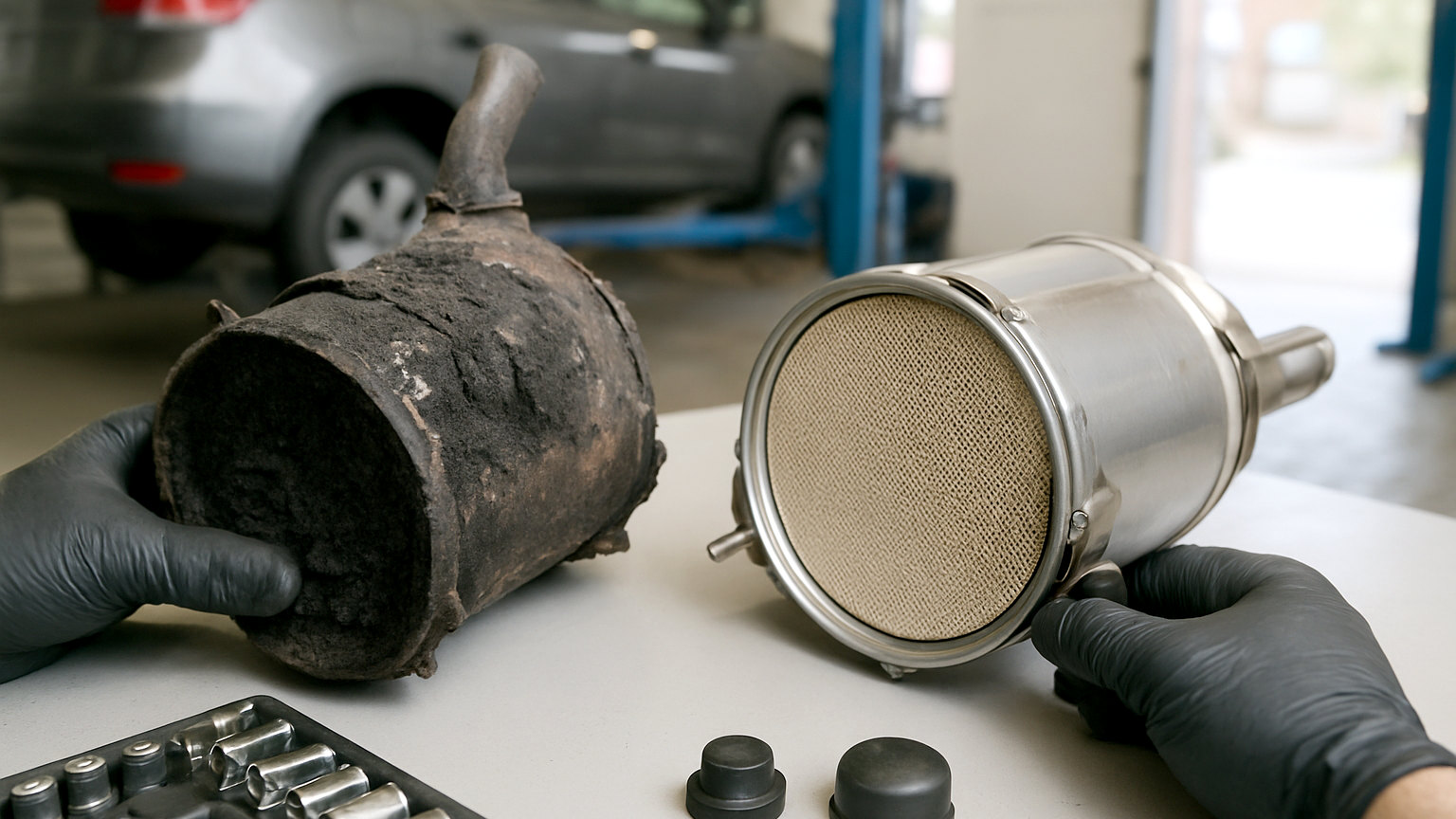
Testers check for the presence of a diesel particulate filter where one was fitted from new, and a vehicle found with it removed is a failure. The same applies to a catalytic converter. Beyond the test, using a vehicle on the road with emissions equipment removed is an offence and can affect insurance, so this is not a route worth considering however tempting the short term saving appears.
Can a car be prepared to pass?
Legitimately, yes, and it is worth doing. A car presented cold, with old oil, an overdue air filter and a partially loaded particulate filter is being set up to fail. Getting the engine thoroughly hot before the test genuinely matters, since a properly warm engine and exhaust burn more completely. A recent oil change reduces the hydrocarbons that come from crankcase vapour, and a long motorway run beforehand helps a diesel regenerate its filter.
What if it fails on emissions?
The failure identifies which reading was out of range, and that is a genuinely useful diagnostic starting point. High carbon monoxide with high hydrocarbons suggests rich running. High hydrocarbons alone can indicate a misfire or oil burning. On a diesel, high opacity points at injectors, boost or the particulate filter. Ask for the printout, since the actual figures tell a mechanic much more than the word fail does.
Is it worth fixing before the test?
Almost always. A car producing enough smoke to worry about is producing it because something is wrong, and that something is usually damaging the catalytic converter or particulate filter in the background. Fixing the cause before the test avoids a failure, a retest and the possibility that the exhaust components have been ruined by the time you get around to it. The smoke is the symptom, not the problem.
If the test is imminent and the fault cannot be sorted in time, it is still worth presenting the car properly warmed through, since a cold engine will produce worse figures than the same car half an hour later.


