
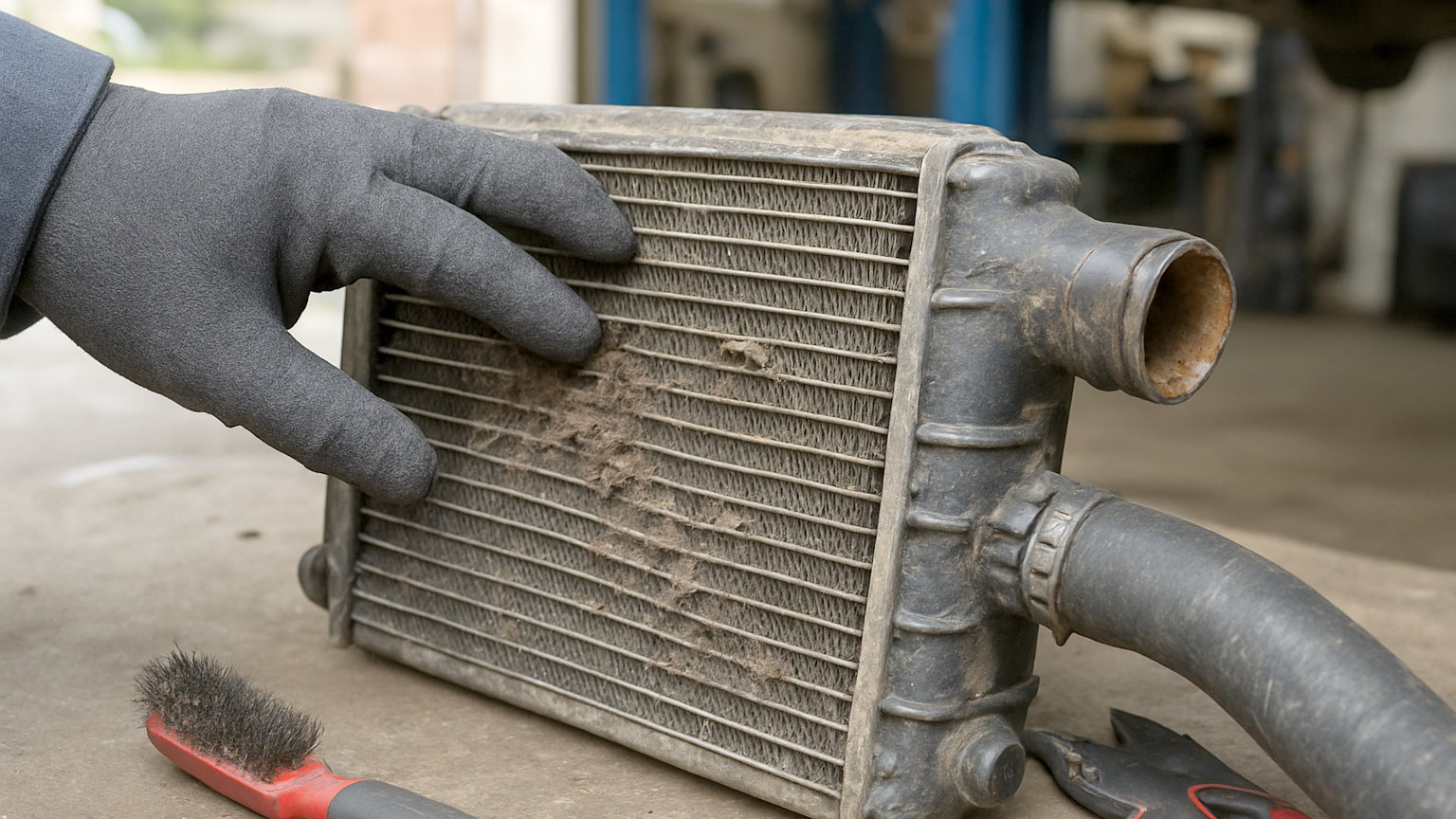
Radiators rarely fail all at once. They lose capacity gradually over years, blocking from the outside with everything the road throws at them and from the inside with the debris of a cooling system that has been left too long between services. Because the decline is slow, the car copes right up until the first hot day or the first towing trip, at which point the missing capacity becomes obvious.
What blocks the outside of a radiator?
Air passing through the front of a car carries insects, leaves, seeds, dust, road salt and grit, and the fins of a radiator are exactly the right shape to catch all of it. On cars fitted with air conditioning, the condenser sits in front and takes the worst of it first, so a matted condenser can starve a perfectly clean radiator of air. Shine a torch from the engine side and look for daylight through the core; where you see a dark mat instead, airflow is being lost.
How should the outside be cleaned?
Gently, and from the engine side outwards so the debris comes back out the way it went in. A garden hose at low pressure and a soft brush are appropriate. A pressure washer is not, because the aluminium fins are thin enough to be flattened by it, and flattened fins block airflow permanently in a way that no amount of subsequent cleaning will undo. Where the gap between the condenser and radiator is packed solid, the two may need separating properly, which is a garage job.
What blocks the inside?
Coolant contains corrosion inhibitors with a finite life, and once they are exhausted the aluminium, iron and copper components in the system begin to corrode. The resulting sediment collects in the narrowest passages, which means the radiator core and the heater matrix. Old coolant also degrades chemically and can become acidic, accelerating the process. This is precisely why coolant is a service item with a replacement interval rather than a fill-for-life fluid, whatever a previous owner may have assumed.
How can you tell if a radiator is blocked internally?
With the engine hot, an infrared thermometer across the face of the radiator should show a fairly even temperature gradient from the top inlet to the bottom outlet. Distinct cold patches indicate tubes that are no longer flowing. Without a thermometer, a car that overheats under sustained load with a working fan, correct coolant level and a functioning thermostat is displaying the classic profile of a partially blocked core, and a look at the colour and clarity of the coolant usually supports it.
Does flushing actually work?
Sometimes, on a system caught early. A proper flush with a suitable cleaner circulated through the system, followed by a full drain and refill with the correct coolant, can restore a good deal of flow. It is far less effective on a core that has been silted up for years, and aggressive chemical flushes on old cars have a habit of clearing debris away from corroded areas and revealing leaks that the sediment was effectively plugging. That is not the flush causing damage so much as exposing it, but the outcome is the same.
When is replacement the sensible answer?
When the core is visibly corroded, when there are multiple cold spots, when a previous flush has not fixed the overheating, or where the radiator is already weeping from a seam. Radiators on most mainstream cars are not particularly expensive parts and the labour is often straightforward, so replacing a tired one is frequently cheaper than repeated attempts to rescue it. Whichever route you take, fill the system with the correct coolant specification and bleed it fully, because an airlock will reproduce all the same symptoms in a brand new radiator. It is also worth clearing the condenser and the gap behind it while everything is apart, since that access rarely comes around twice.


