
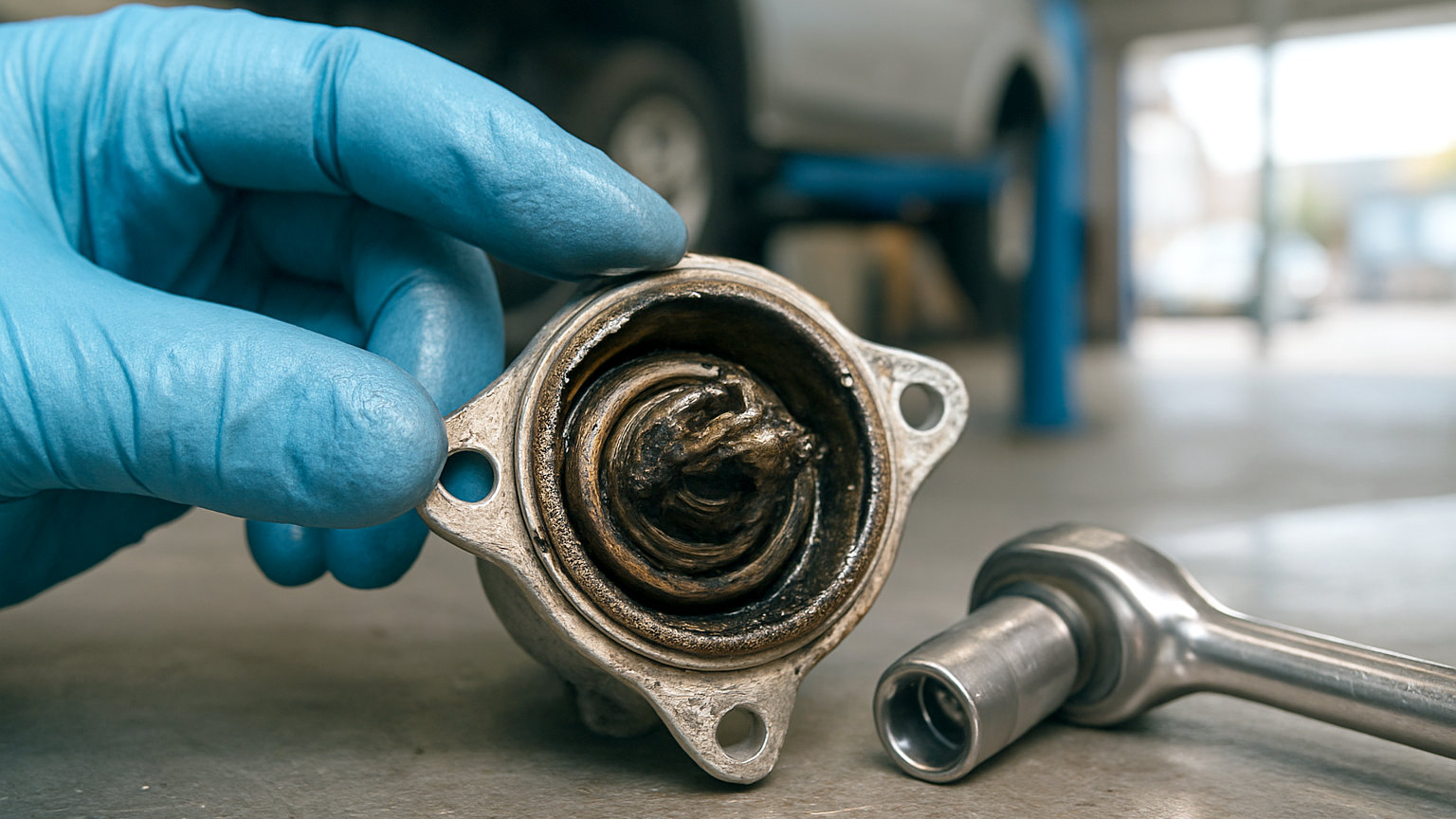
The thermostat is one of the smallest and cheapest components in the cooling system and one of the most consequential when it fails. Its job is to keep coolant inside the engine until working temperature is reached, then open and allow it to circulate through the radiator. It can fail closed, which causes rapid overheating, or fail open, which stops the engine ever getting properly warm, and the two produce almost opposite complaints.
What happens when it sticks closed?
Coolant is trapped in the engine block with no route to the radiator, so it heats up with nowhere to shed that heat. The temperature gauge climbs quickly and steadily from a cold start, often reaching the red within five or ten miles regardless of whether you are moving or stationary. This consistency is the giveaway, because a fan fault causes overheating in traffic and a thermostat fault causes it everywhere, including on an open road where airflow ought to be plentiful.
What are the symptoms of one stuck open?
The opposite picture, and one that many drivers ignore for months because the car does not appear to be in trouble. Coolant circulates continuously, so the engine takes far longer than usual to reach normal temperature, the gauge may never reach the middle, and the heater blows lukewarm air even after a long journey. Fuel consumption rises noticeably, because the engine management keeps the mixture rich while it believes the engine is still warming up, and long term running below temperature increases wear and can cause condensation and sludge in the oil.
Is there a simple test?
There is, and it needs nothing but patience and care. Start the car from stone cold and feel the top radiator hose. It should stay cool for several minutes while the engine warms, then become hot quite suddenly as the thermostat opens and hot coolant is released into the radiator. A hose that stays cool while the gauge climbs towards the red means the thermostat has not opened. A hose that is warm almost from the start suggests it never closed. Keep hands well clear of the fan and belts while doing this, and never touch a hose that may already be at boiling point.
Why do thermostats stick?
Age and coolant condition account for most failures. The wax capsule that operates the valve wears out over many thousands of heat cycles, and corrosion or debris in a system that has not had a coolant change in years can jam the mechanism physically. This is why a thermostat failing is often a signal about the state of the whole system rather than an isolated event, and why the coolant is normally worth replacing at the same time.
Can you drive with a failed thermostat?
One stuck open is not dangerous in the short term, though the car will be uncomfortable in winter and thirstier than it should be, and it should be dealt with rather than tolerated. One stuck closed is a different matter entirely and should not be driven on, because the engine will overheat within a few miles and heat damage to an aluminium head is expensive and permanent. Removing the thermostat altogether as a temporary fix is an old trick that causes its own problems and is not worth doing on a modern engine.
What does replacement involve?
The part itself usually costs very little. Labour varies enormously depending on where the housing sits, since some are accessible from the top of the engine in twenty minutes and others require the removal of the inlet manifold or the auxiliary belt. The system has to be drained and then properly refilled and bled afterwards, because air trapped in the block causes overheating that looks exactly like the original fault. A proper bleed is the step that gets skipped most often and causes the most comebacks, so it is worth asking whether it has been done properly before accepting that the car is fixed.


