
A car that runs at a perfectly steady temperature around town and starts creeping upwards after forty miles of motorway is describing a different fault from one that boils in a traffic queue. Nothing has failed completely, because the system clearly works under light load. What has happened is that the cooling capacity has been eroded to the point where it can handle a school run and cannot handle sustained high output, and that narrows the causes considerably.
Why does load matter so much?
An engine cruising at seventy for an hour produces far more heat, continuously, than the same engine pottering between junctions. Around town it also gets long periods of light load in which to recover. On a motorway there is no recovery period, so any shortfall in cooling capacity accumulates rather than evening out. This is why hills, towing, a fully loaded car and hot weather all bring the fault forward, and why the same car may have been fine on the identical journey in March.
What blocks a radiator internally?
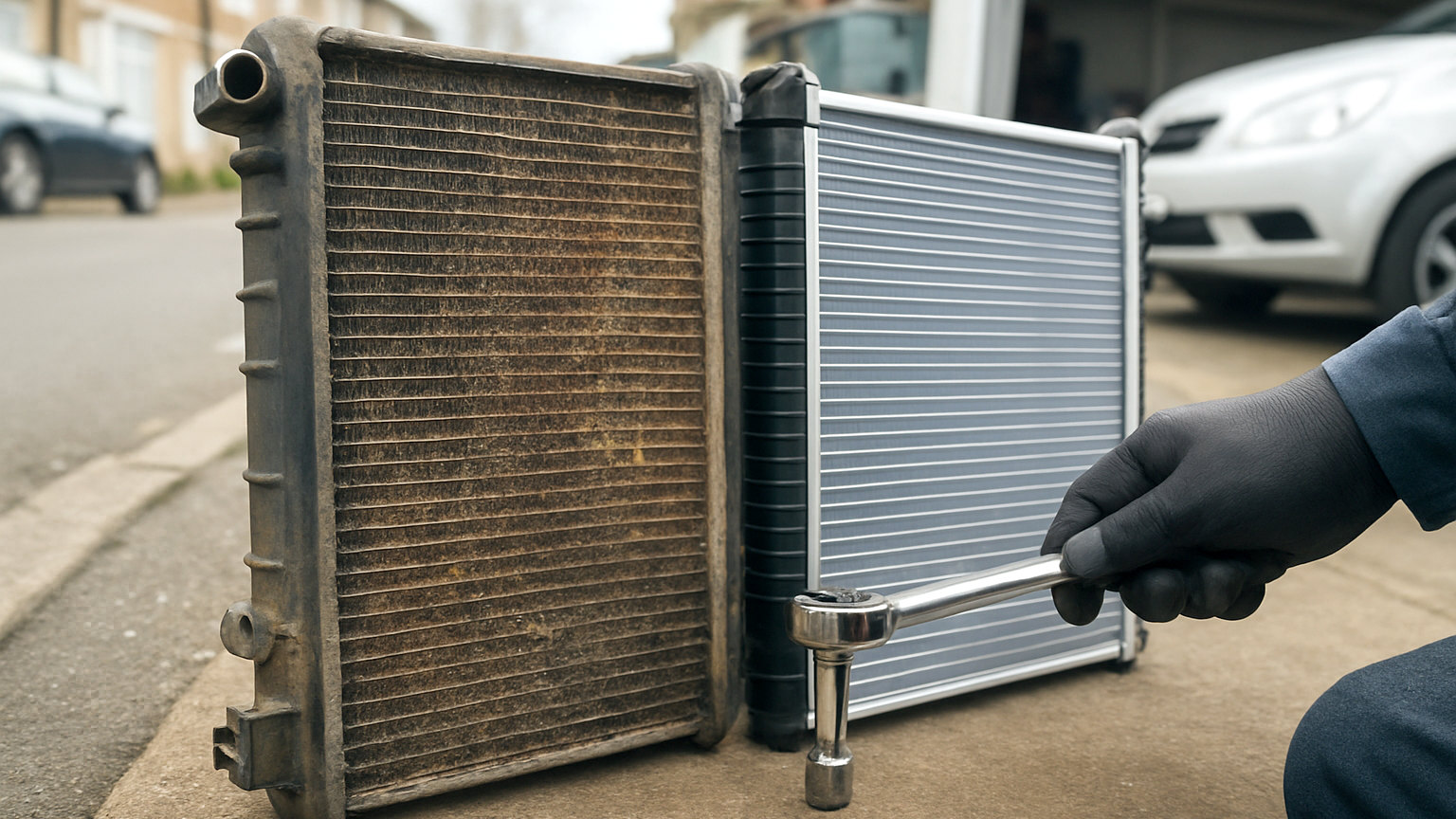
Coolant contains corrosion inhibitors that are consumed over time, and once they are exhausted the system begins to corrode from the inside. The resulting sediment settles in the narrow tubes of the radiator core and reduces flow, and because it happens gradually there is no single moment where the car stops coping. A radiator that is noticeably cooler in patches when the engine is hot, or a system that has never had a coolant change in eight years, fits this pattern well.
Can the outside of the radiator be the problem?
Frequently, and it is easier to check. Fins pack solid with insects, leaves, dust and road grime, especially on cars that do a lot of rural or motorway miles, and an air conditioning condenser mounted in front collects the same debris first. Shine a torch through the grille and look for daylight through the fins. A gentle rinse from the engine side outwards with a low pressure hose removes a surprising amount, though a pressure washer will flatten the fins and make things permanently worse.
Could the water pump be weak rather than failed?
Yes, and this is a classic long journey fault. Impellers corrode or, on some designs, the plastic impeller slips slightly on its shaft, so the pump still moves coolant but not as much as it should. At low speeds and low heat output that reduced flow is adequate; under sustained load it is not. There is often no noise and no leak, which makes it a difficult fault to prove without measuring temperatures across the system, but it should be on the list once the obvious causes are eliminated.
Is a slight coolant loss enough to cause this?
It is. A system that is half a litre low still fills the passages at low temperature and low pressure, but the reduced volume and the air pocket that replaces it cut capacity at exactly the moment capacity is needed. Air also collects at high points and can sit against a temperature sensor, giving readings that swing oddly. Check the level cold before every long trip on a car that has ever needed topping up, and treat a repeat top up as a leak to be found rather than a routine chore.
What should you do on the journey itself?
Ease off rather than pressing on, since reducing load reduces heat output immediately. Turn the air conditioning off and the heater on full if the gauge is climbing, and use the next services rather than the one after. If the car settles down at sixty but climbs at eighty, that is genuinely useful diagnostic information worth passing on. Book a coolant change and a pressure test rather than assuming a car that recovers when you slow down has fixed itself, because the underlying capacity loss will keep getting worse and the weather will not always be on your side.


