
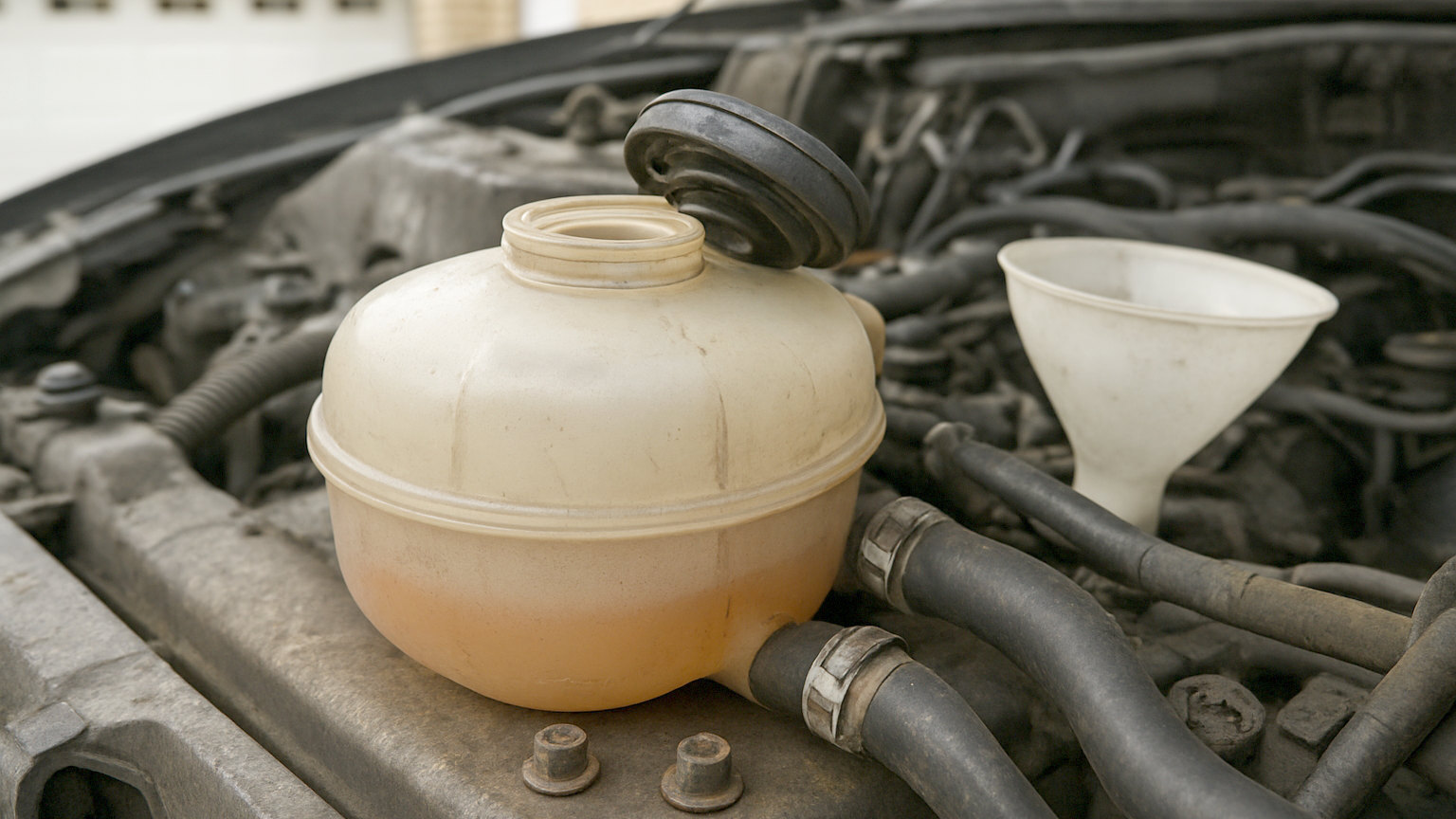
Checking coolant is among the simplest things you can do for a car and one of the most neglected, largely because the modern expansion tank is opaque enough to be easy to ignore. It takes about two minutes, needs no tools, and it catches the slow losses that turn into overheating on the first hot day of the year. There is one absolute rule attached to it, which is that a hot cooling system must never be opened.
Why does the engine have to be cold?
The system is deliberately pressurised so that coolant can exceed one hundred degrees without boiling. Removing the cap releases that pressure instantly, and the superheated liquid flashes to steam and erupts out of the filler neck. This causes serious scalding injuries every year, and there is no careful technique that makes it safe. Wait until you can comfortably rest your hand on the top radiator hose, which normally means at least half an hour and often longer on a warm day.
Where do you actually look?
Almost all modern cars have a translucent plastic expansion tank in the engine bay with minimum and maximum marks moulded into the side. The level should sit between them when the engine is cold, and it will read higher when hot because the coolant expands, which is the whole point of the tank. Check it on level ground and look at the actual liquid level rather than at the staining left behind by an older, higher level, which catches people out surprisingly often.
Which coolant should you use?
Modern coolants are not interchangeable, and the colour is not a reliable guide because manufacturers use different dyes for the same chemistry. What matters is the specification listed in the handbook, usually an OAT, HOAT or IAT type with a manufacturer approval code. Mixing incompatible types can cause the additives to react and form a gel that blocks the radiator and heater matrix. If you do not know what is in the system, the safe approach is to have it drained and refilled with the correct type rather than adding something that may not be compatible.
Can you use plain water?
In an emergency, yes, and it is far better than running an engine with no coolant at all. Water alone offers no frost protection, no corrosion inhibition and a lower boiling point, so it is a way of getting home and nothing more. Ideally use pre-mixed coolant of the correct type, or concentrate diluted with distilled water, and add it slowly. Never pour cold liquid into an engine that is still hot, because the sudden temperature change can crack a cylinder head.
How often should it be checked?
Monthly is sensible for most cars, and before any long journey, since a slow loss shows up as a gradual fall over weeks rather than a dramatic event. Coolant itself has a service life, typically somewhere between three and ten years depending on type, because the corrosion inhibitors are consumed over time. Old coolant looks dull, brown or rusty rather than bright, and coolant in that condition is allowing the inside of the engine and radiator to corrode.
What does a falling level actually mean?
That there is a leak, because a sealed system does not consume coolant. A drop of a few millimetres over a year is unremarkable, but anything that needs regular topping up should be investigated with a pressure test. Topping up is not a repair, and a level that keeps falling will eventually fall far enough to stop circulation entirely, usually at the least convenient moment. Note how much you add and when, since that record is genuinely useful to whoever ends up diagnosing it.
Keep a sealed container of the correct pre-mixed coolant in the boot if the car has any history of losing it, because the alternative at the roadside is either plain water or whatever a petrol station happens to stock, and neither is ideal for a system that has already proved it cannot hold what it was given.


