
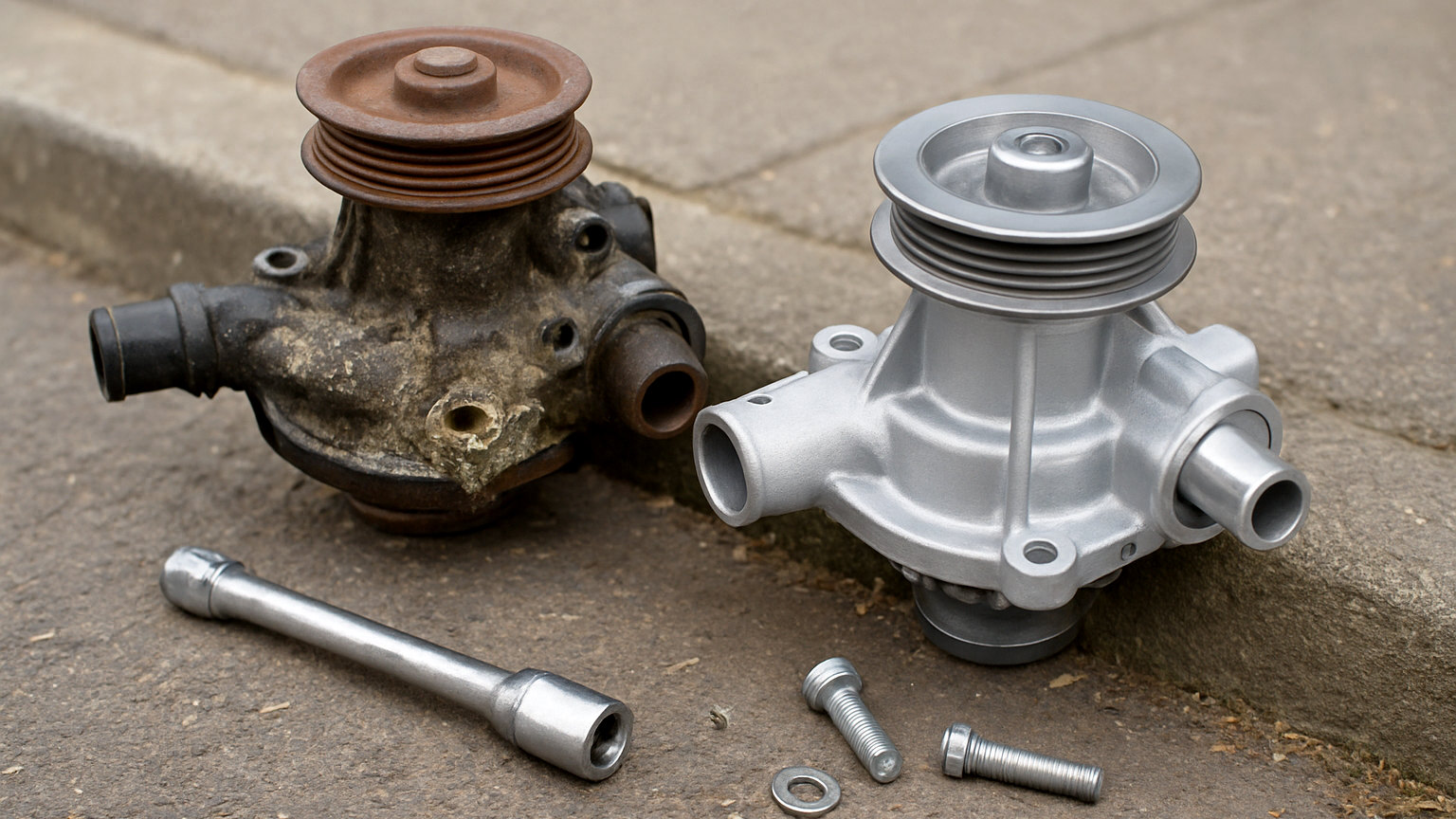
The water pump is the heart of the cooling system, driven by the auxiliary belt or the timing belt and responsible for keeping coolant moving through the engine and radiator. When it fails completely, circulation stops and overheating follows within minutes regardless of speed or airflow. The good news is that pumps rarely fail without warning, and the warnings are specific enough to recognise if you know what you are listening and looking for.
What noise does a failing pump make?
The bearing is usually the first thing to go, and it produces a whine or a low growl from the front of the engine that rises and falls with engine speed rather than road speed. It is often more obvious from cold and may fade as everything warms and expands. Because several belt-driven components sit in the same area, distinguishing a pump from an alternator or a tensioner pulley by ear alone is difficult, which is why a mechanic will use a stethoscope or listening rod rather than guessing.
What is the weep hole telling you?
Water pumps have a small drain hole in the housing, designed so that when the internal seal begins to fail, coolant escapes visibly outside rather than running into the bearing and destroying it. Dried coolant staining around that hole, a crusty coloured deposit on the pump body, or a damp patch behind the pulley are all early signs of a failing seal. It is by design an early warning, and a pump weeping slightly today will be leaking properly within weeks.
How do you check for bearing play?
With the engine off and cold, take hold of the pump pulley and try to rock it. There should be no perceptible movement at all in any direction, and no roughness when it is turned. Any wobble, any grinding feel or any noise as it rotates means the bearing has worn and the pump is close to the end. On engines where the pump is driven by the timing belt and hidden behind covers, this check is not possible without dismantling, which is one of the reasons for replacing the pump alongside the belt.
Why do so many pumps fail without any noise at all?
Because the impeller can degrade independently of the bearing. Corrosion eats away the vanes of a metal impeller, and plastic impellers used on some engines can slip on their shaft or lose blades entirely. Either way the pump turns silently, appears perfectly healthy, and moves far less coolant than it should. The symptom is overheating under load with no noise, no leak and no obvious cause, which is exactly why this fault frustrates people for months before it is found.
What happens if it fails completely?
Circulation stops and engine temperature rises very rapidly, often faster than the gauge can respond, because the coolant sitting around the temperature sensor is no longer being replaced. If the pump seizes and it is driven by the timing belt, the belt can be stripped or thrown, which on an interference engine means pistons meeting valves and a repair bill on a par with a replacement engine. This is the reason pump failure is treated more urgently than most cooling faults.
Should it be replaced with the timing belt?
On any engine where the timing belt drives the pump, almost always. The labour to reach the pump is nearly all of the labour to change the belt, so fitting a new pump at the same time adds a modest part cost and removes the risk of having to do the whole job again in two years. Refusing that offer to save a small amount is one of the more expensive economies available to a car owner, and most garages will decline to guarantee the belt job without it. The same reasoning applies to the tensioner and idler pulleys, which live in the same place and wear at a similar rate.


