
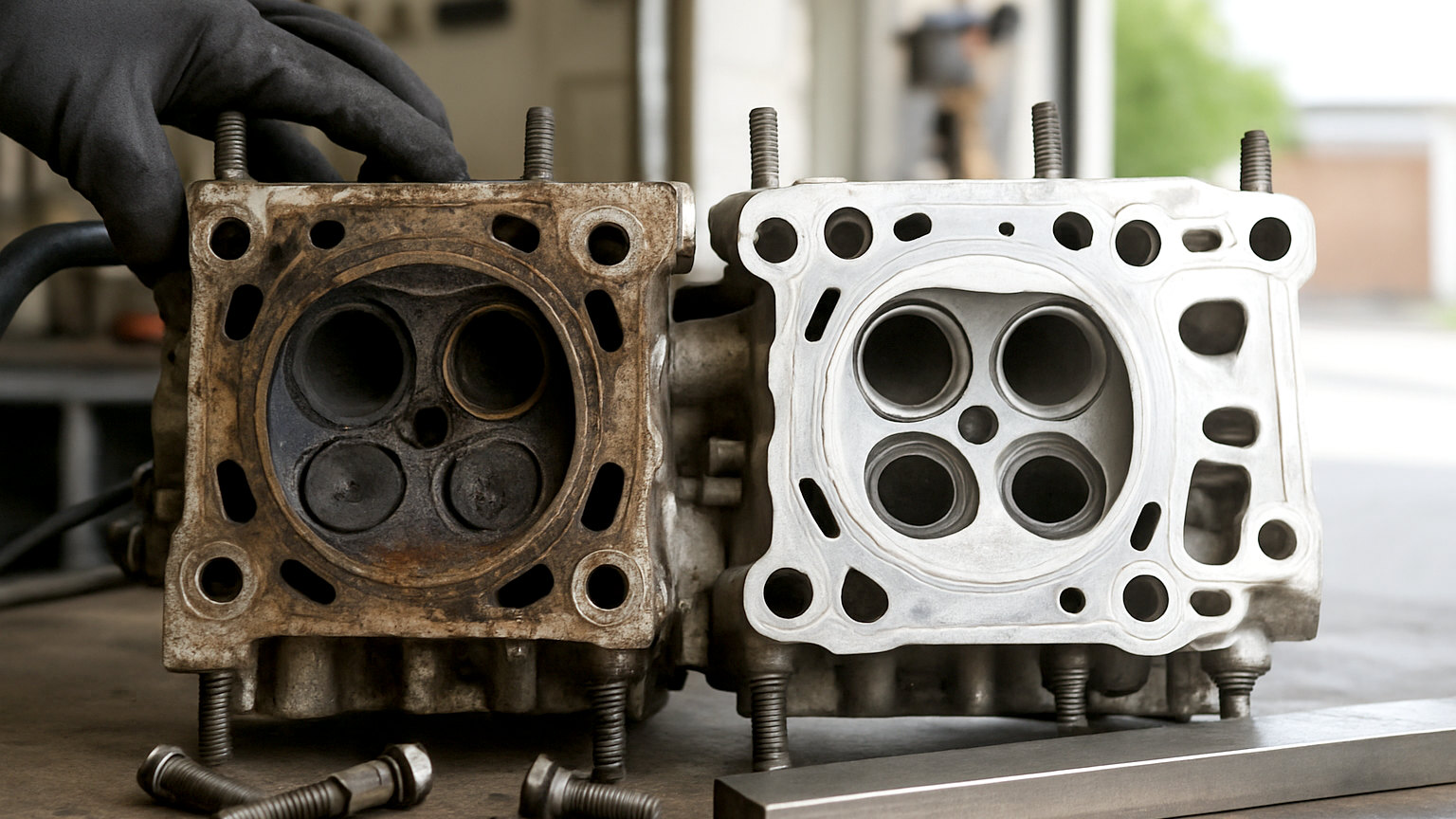
Advice about overheating always ends with an instruction to stop the car, and it is usually delivered without explanation, which makes it easy to treat as excessive caution. Knowing what actually happens inside a hot engine changes that, because the damage is progressive, it starts earlier than most people assume, and some of it cannot be undone at any price. The distance between a cheap repair and a scrapped engine is often measured in single miles.
What happens to the cylinder head first?
Most modern engines have an aluminium cylinder head bolted to a cast iron or aluminium block, and aluminium expands more with heat than the components it is clamped to. Once temperatures exceed the design range, the head distorts, usually bowing slightly in the middle. That distortion crushes the gasket unevenly and breaks the seal between combustion chambers, coolant galleries and oil passages. The result is a failed head gasket, and if the warping is significant the head must be machined flat or replaced before a new gasket will hold.
Why is a head gasket failure so consequential?
Because it connects three systems that must never meet. Combustion gases forced into the coolant pressurise the system and push coolant out, which reduces the coolant volume and makes overheating worse, creating a loop that accelerates. Coolant entering the oil turns it into an emulsion that cannot lubricate, and coolant entering a cylinder cannot be compressed, which in severe cases bends a connecting rod. What began as a stuck thermostat becomes a bottom end failure.
What does heat do to the oil?
Engine oil is formulated to work within a temperature range, and beyond it the additives break down and the base oil oxidises. Oil that has been badly overheated thickens, forms varnish and sludge, and loses much of its ability to carry heat away from bearings and cylinder walls. That damage persists after the engine cools, which is why an oil and filter change is part of putting an overheated engine right rather than an optional extra.
Can pistons and bores be damaged?
In severe cases, yes. Aluminium pistons expand faster than the bores they run in, and if temperatures go high enough the clearance disappears and the piston scuffs against the cylinder wall. This scores both surfaces permanently, causes oil consumption and loss of compression, and is not repairable without a rebuild. In the worst instances the piston seizes outright, which usually stops the engine and ends its life. Cars in this condition often gave clear warnings that were driven through.
What else fails as a consequence?
Plastic and rubber components throughout the engine bay suffer. Hoses harden and split, plastic coolant housings and thermostat bodies distort and crack, and seals shrink and leak. These faults appear weeks or months after the overheating event, which is why a car that overheated in July can develop an apparently unrelated coolant leak in September. Catalytic converters can also be damaged if unburnt coolant reaches them through a leaking gasket.
Is an overheated engine ever fine afterwards?
Often, yes, and this is worth saying plainly. An engine that reached the red briefly, was stopped promptly and cooled properly frequently suffers no lasting harm at all. The damage described here comes from sustained overheating or from continuing to drive after the warning. A proper inspection afterwards, including a compression test, a combustion gas test and an oil change, will establish which situation you are in and is money well spent before assuming the worst or assuming everything is fine.
What should you watch for in the weeks afterwards?
Keep an eye on the coolant level, the oil condition and the exhaust for the next few hundred miles, because damage that was marginal at the time tends to declare itself gradually. A slowly falling coolant level, a creamy film appearing under the filler cap, a misfire that was not there before or a heater that has stopped working are all signs that the event did more harm than the initial inspection suggested, and finding out early is considerably cheaper than finding out on a motorway.


