
Knocking is the noise drivers worry about most, and with reason, because one version of it is a fuel quality issue that costs almost nothing to resolve and another is the sound of an engine destroying itself. The two are quite distinguishable once you know what separates them, and the deciding factor is not the volume of the noise but the circumstances in which it appears.
What is the first question to ask?
Not what the noise sounds like, but when it happens. A knock that appears only under load, climbing a hill or accelerating hard in a high gear, is a combustion problem. A knock that is present at idle, rises and falls with engine speed regardless of load, and gets worse as the engine warms is a mechanical problem in the rotating assembly. Establishing which of those two patterns you have narrows the possibilities down to a handful before anything is dismantled.
What is pinking and why does it knock?
Pinking, sometimes called detonation or pre-ignition, happens when the fuel and air mixture ignites spontaneously ahead of the spark rather than burning smoothly outwards from it. The two flame fronts collide and the resulting pressure spike rings the metal, producing a sound like marbles rattling in a tin. It shows up under load, on hills, and in hot weather, and it is often caused by low octane fuel, carbon deposits in the chambers, an over-advanced ignition timing or an engine running hotter than it should.
The cure is frequently as simple as a tank of higher octane fuel followed by a decent run to clear deposits. If the knocking persists on good fuel, the engine management may be compensating for a failed knock sensor, and that is worth having read on a diagnostic tool since it also affects performance and economy.
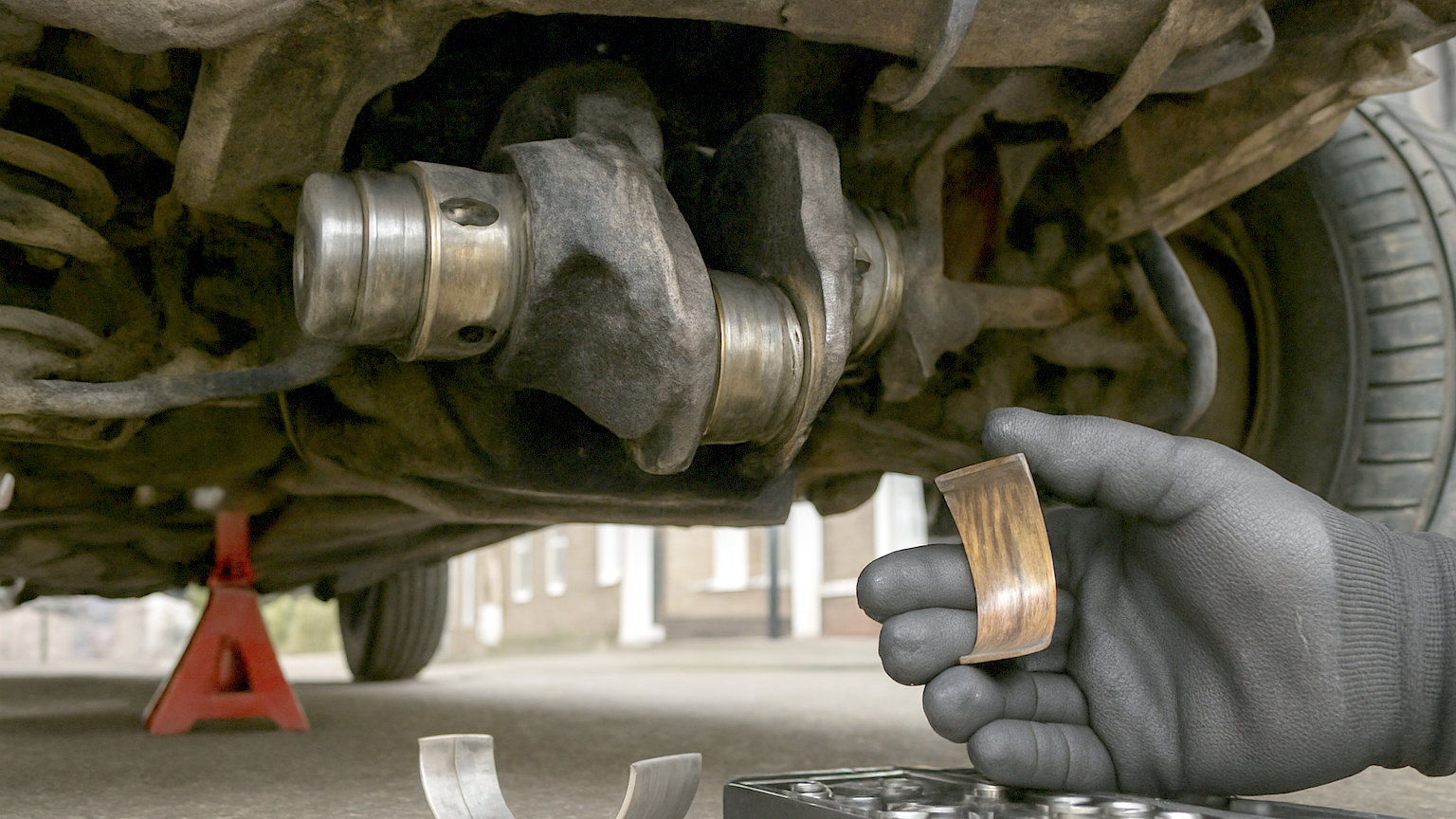
What does a big end bearing knock sound like?
Deeper, heavier and more rhythmic, described by most people as a hollow thumping from low down in the engine rather than a metallic rattle from the top. It usually appears first at idle when the engine is warm and the oil has thinned, becomes more obvious on a light throttle at low revs, and may quieten momentarily when the engine is loaded. It is frequently accompanied by low oil pressure, an oil warning light that flickers, or a history of running the engine low on oil.
Which knock means stopping immediately?
The deep bottom end knock. A worn big end bearing does not recover, and continuing to drive turns a repairable engine into a scrap one, often within a few hundred miles, because the failing bearing contaminates the oil with metal and damages everything else it circulates through. If the noise is deep, rhythmic, present at idle and accompanied by any oil pressure warning, switch the engine off and have the car recovered rather than driving it to a garage.
Could it be something less serious?
Frequently. A loose heat shield resonating against the exhaust produces a metallic rattle that sounds alarming and costs almost nothing to fix. Worn hydraulic lifters produce a lighter tapping from the top of the engine. A failing auxiliary belt tensioner can knock rhythmically at low revs. Even a loose engine mount will let the engine move enough to knock against something under load. None of these are pleasant, but none of them are terminal.
How do you narrow it down yourself?
Note whether it changes with engine speed or road speed, whether it is present at idle or only under load, whether it improves or worsens as the engine warms, and whether the oil level and pressure are correct. Check the oil first, since running low is the most common cause of bearing wear and topping up will not fix a noise that has already started. Then take those observations to a garage rather than a parts shop, because a knock diagnosed by ear alone is guesswork and the wrong guess here is expensive.


