
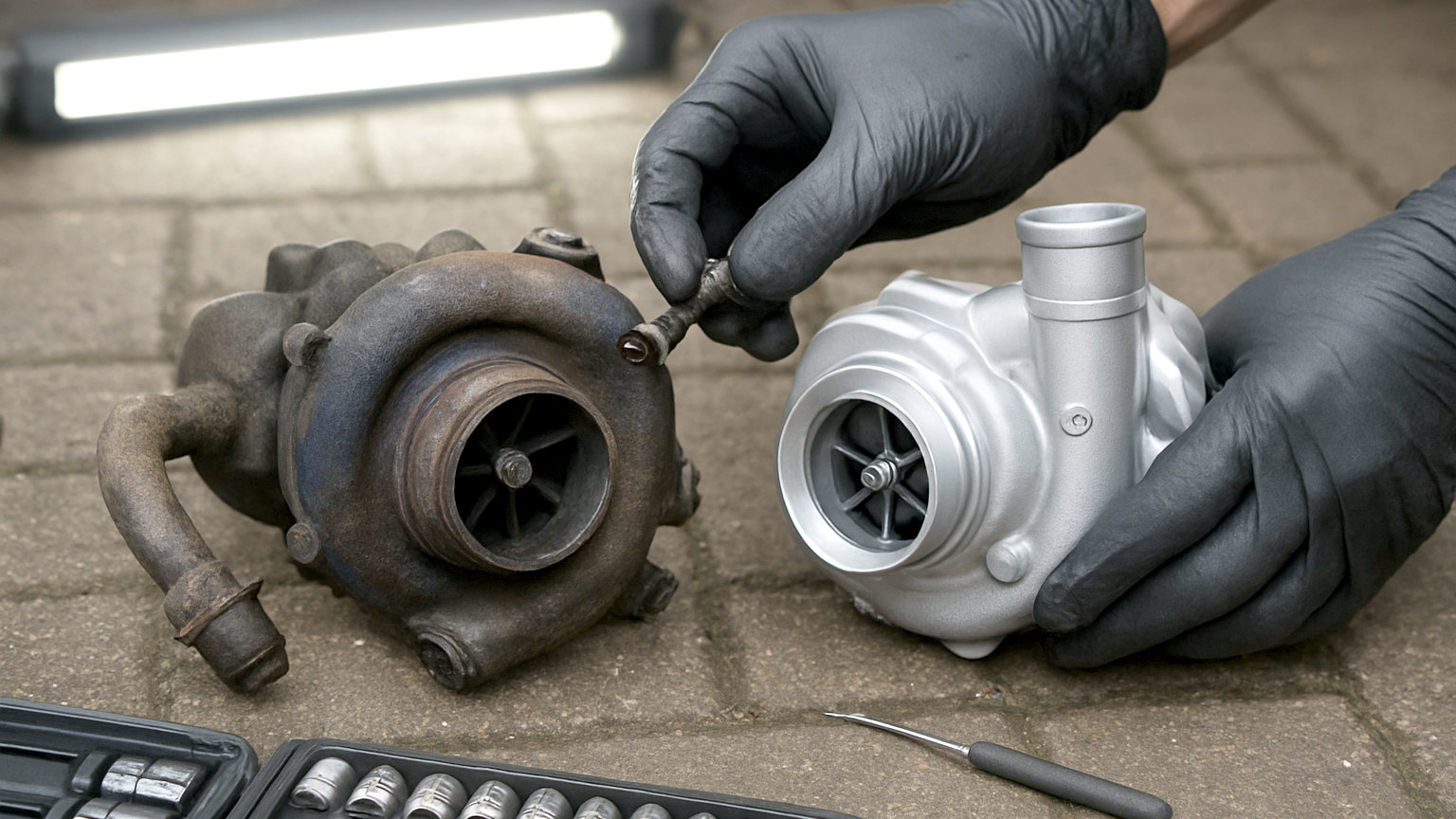
Turbochargers are among the fastest spinning components ever fitted to a road car, reaching well over a hundred thousand revolutions per minute, and they make noise as a matter of course. That makes them difficult to assess by ear, because a healthy turbo whistles and so does a failing one. What separates them is whether the noise has changed, what it sounds like at the extremes, and what else is happening at the same time.
Which turbo noises are normal?
A soft rising whistle as boost builds under acceleration is entirely normal, and on many cars it is more audible with the window down or in a tunnel. A faint whoosh as the pressure releases when you lift off is also normal on cars fitted with a recirculation valve. If the noise has always been there, has not changed, and the car pulls exactly as it should, there is generally nothing to investigate. Familiarity is the baseline against which everything else is judged.
What does a boost leak sound like?
A sharper, more urgent hiss or whistle that appears under acceleration and is often accompanied by a car that feels flat, hesitant or noticeably down on power. The leak is usually in the pipework between the turbo, the intercooler and the inlet manifold, where a hose has split or a clamp has loosened. These pipes are often oily around the leak because pressurised air carries a fine mist of oil with it, so a visual inspection of the intercooler pipework frequently finds it.
What is fluttering?
A rapid chattering or fluttering when you lift off the throttle, sometimes called compressor surge, occurs when pressurised air has nowhere to go and pushes back through the compressor wheel. On cars designed to recirculate that air, it usually means the diverter or dump valve is not working properly or a hose to it has come off. It is not the badge of tuning many people believe it to be on a standard car, and repeated surge is not good for the compressor bearings.
Which noise suggests the turbo is failing?
A harsh siren-like screech, a noise that has become noticeably louder over a short period, or a grinding or rumbling that is present even at low boost. These suggest the shaft bearings have worn, allowing the compressor wheel to contact the housing. The associated symptoms are loss of power, blue smoke from the exhaust as oil passes through worn seals, high oil consumption and sometimes a warning light for underboost or overboost. Any combination of these deserves prompt attention.
Why is a failing turbo urgent?
Because when the compressor wheel breaks up, the debris travels straight into the inlet manifold and then into the engine, turning a turbo replacement into a rebuild. Oil finding its way past the seals into the intake can also cause a diesel to run on its own lubricating oil, which is uncontrollable and destroys the engine. This is why a turbo suspected of failing should be inspected rather than driven on while you save up for it.
How do you make a turbo last?
Oil is everything, because the bearings are lubricated and cooled by engine oil at very high speeds and temperatures. Keep to short change intervals with the correct specification, allow the engine a minute of gentle running before working it hard from cold, and give it a short idle after a hard drive before switching off so the oil can carry heat away rather than baking in the bearing housing. Most premature turbo failures trace back to oil supply rather than to the turbo itself.
Frequent short journeys are particularly hard on a turbo, because the unit gets hot without the oil ever reaching a temperature at which it can shed contaminants. If the car spends most of its life on short trips, shortening the oil change interval below the manufacturer figure is money well spent rather than excessive caution.


