
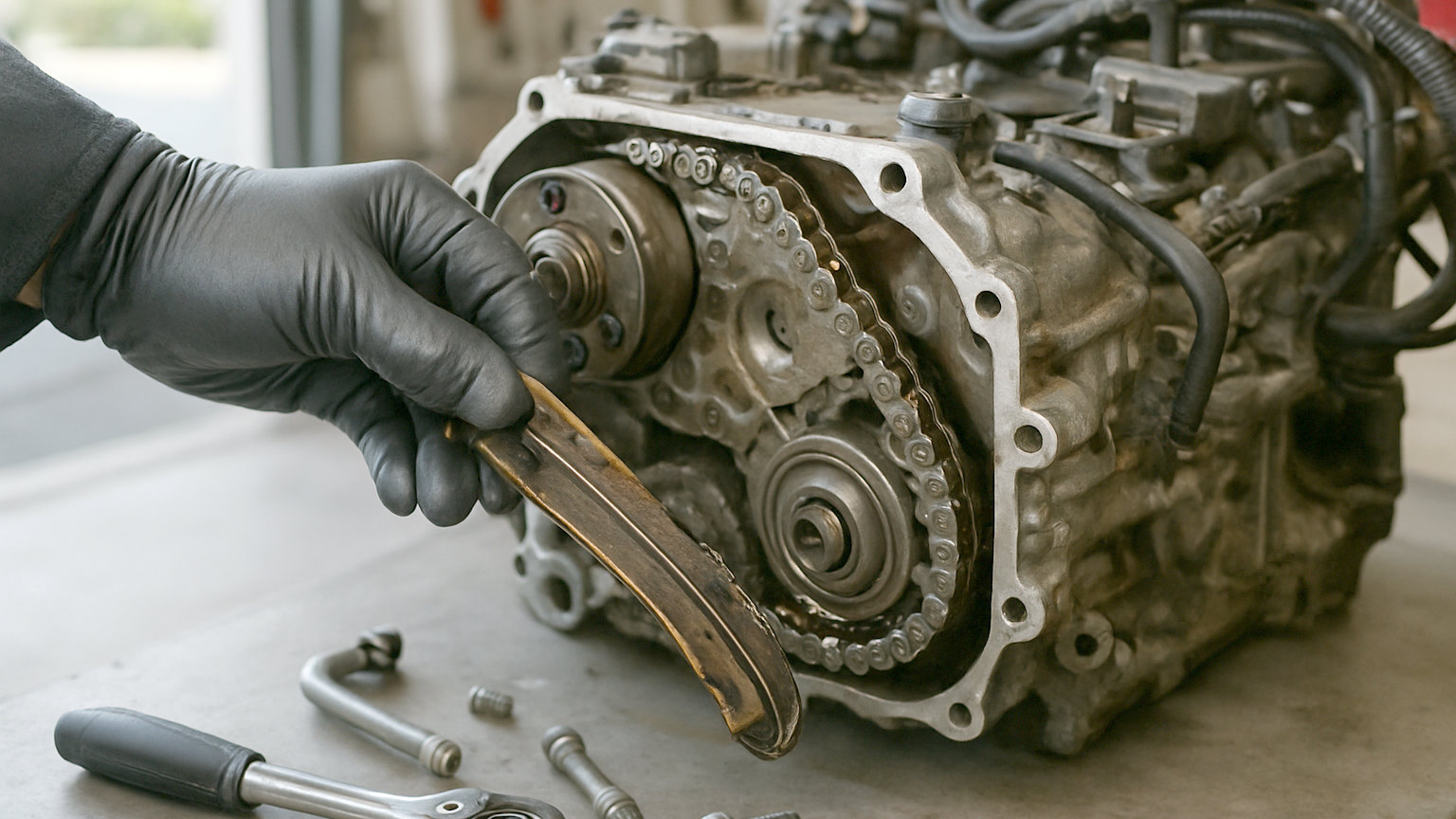
Timing belts have a published replacement interval and everybody knows they must be changed. Timing chains were sold on the promise that they would last the life of the engine, and on many designs they do. On others they stretch, the plastic guides wear and the tensioner loses its ability to take up slack, and the first indication most owners get is a rattle at startup that nobody warned them about.
What does the chain actually do?
It links the crankshaft to the camshafts so that the valves open and close in exact relation to the position of the pistons. That relationship has very little tolerance, and modern engines with variable valve timing depend on it being precise across the whole rev range. A chain that has stretched by a few millimetres allows the camshafts to lag, which the engine management detects, and a chain that jumps a tooth changes the timing enough to cause serious mechanical damage.
What does the noise sound like?
A dry metallic rattle from the end of the engine where the chain runs, most obvious in the first one to three seconds after a cold start before oil pressure reaches the tensioner. Early on it may be present only after the car has stood overnight. As wear progresses it lasts longer, appears after shorter stops, and eventually becomes audible at idle when warm and during gearchanges. The progression from a brief startup rattle to a constant one usually takes months rather than years.
What warning lights and codes appear?
The engine management light frequently comes on with camshaft position correlation codes, which means the computer has compared the crankshaft and camshaft signals and found them out of step. Owners often report reduced power, rough idling, poor fuel economy, and occasionally a car that goes into limp mode. Because those codes name the relationship rather than the part, they are sometimes misread as a sensor fault, which is why a chain measurement matters before parts are bought.
Why does oil condition matter so much?
Because the chain is lubricated by engine oil and the tensioner is hydraulic, operating on oil pressure. Oil that is old, low, of the wrong viscosity or contaminated allows the chain to run less well lubricated and delays the tensioner in taking up slack, particularly at startup. Long service intervals on engines already prone to chain wear are a well documented contributor, and shortening the oil change interval is a genuinely effective way of extending chain life on those engines.
What happens if it is ignored?
The chain jumps a tooth or breaks. On an interference engine, which covers most modern designs, the valves and pistons occupy the same space at different times, so a loss of timing means they meet. Bent valves are the minimum outcome, and damaged pistons and cylinder heads are common. At that point the repair frequently costs more than the car is worth, which is why a rattle that is still short and only present on cold starts represents an opportunity rather than a disaster.
What does replacement involve?
A chain kit including the chain, guides, tensioner and sprockets, plus a substantial amount of labour, since reaching the chain usually means removing the front of the engine or, on some designs, dropping the sump or removing the gearbox. Costs vary enormously between engines for exactly that reason. It is worth obtaining more than one quote and asking whether the job includes the guides and tensioner, since fitting a new chain to worn guides is a false economy that produces the same noise within a year.
Is it worth doing?
On a car with plenty of life left, almost always, because the alternative is a destroyed engine at an unpredictable moment. On an older car with high mileage, the arithmetic is less obvious and worth doing honestly against the value of the vehicle. What is not sensible is continuing indefinitely while the rattle gets longer, since the failure mode is sudden and gives no useful warning beyond the noise you can already hear.


