
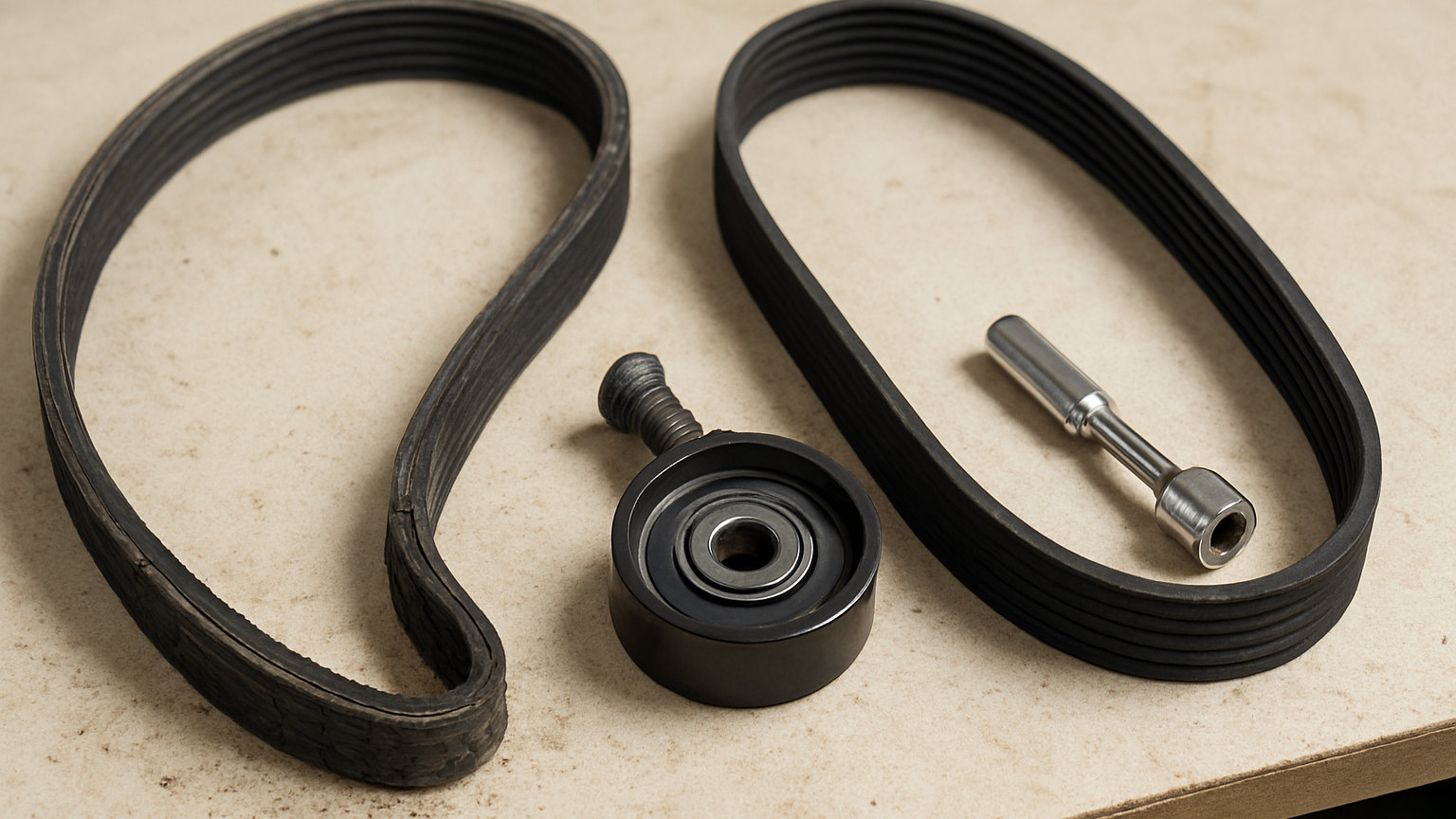
A squeal from under the bonnet is one of the easier engine noises to trace, because there are only a handful of things at the front of an engine capable of making it. Almost all of them are attached to the auxiliary belt, which drives the alternator, the water pump on many engines, the power steering pump and the air conditioning compressor. The circumstances under which the squeal appears will usually identify the culprit before anything is touched.
Why do belts squeal?
A belt transmits power through friction against the pulleys, and when that friction fails it slips and vibrates rapidly, producing the characteristic squeal. Slipping happens when the belt is worn or glazed, when its tensioner has weakened, when it is contaminated with oil or coolant, or when one of the components it drives is suddenly demanding more effort than usual. The last of those is why a squeal that appears only when the air conditioning is switched on or the steering is turned to full lock is so informative.
Why is it worse on cold and damp mornings?
Rubber is stiffer when cold and grips less well, and moisture on the pulley surfaces reduces friction further, which is why a marginal belt squeals for the first thirty seconds on a January morning and behaves perfectly for the rest of the day. Drivers often dismiss this because it goes away, but a belt that squeals when cold is a belt already at the edge of its grip, and it will eventually squeal when warm too. It is a warning rather than a quirk.
How do you tell a belt from a bearing?
A belt squeal changes when load changes: switch the air conditioning on, turn the steering to full lock, or switch on the headlights and rear screen heater to load the alternator, and a slipping belt will squeal harder. A failing pulley bearing tends to produce a more constant screech or grinding that tracks engine speed and is unaffected by what you switch on. Spraying a little water on a running belt is an old test that will briefly change a belt noise and do nothing to a bearing noise, though it should be done with great care around moving parts.
What should you look at with the engine off?
Inspect the belt for cracks across the ribs, missing chunks, fraying edges and a shiny glazed appearance on the contact surface. Check whether it is wet with oil or coolant, since a leak from above will contaminate a belt and no amount of tensioning will cure the resulting slip. Then turn each accessible pulley by hand and feel for roughness, and rock each one to check for play. A pulley that rumbles or wobbles has a failed bearing and will eventually seize.
Why does a seized pulley matter so much?
Because on many engines the auxiliary belt also drives the water pump, and on some designs a shredded auxiliary belt can be drawn into the timing belt cover with catastrophic results. Even where neither applies, losing the belt means losing the alternator and the power steering at the same moment, usually at speed. A bearing that is beginning to rumble should be replaced rather than monitored, and the belt is normally replaced at the same time because it has to come off anyway.
Is belt dressing a fix?
No. Aerosol belt dressings quieten a slipping belt for a few days by making it tacky, which masks the symptom while attracting dirt and accelerating the wear. The proper answer is a new belt and, where fitted, a new automatic tensioner, since a tensioner that has lost its spring tension will shred a new belt as quickly as it shredded the last one. Belts are inexpensive service items and replacing one at the first squeal is one of the better value repairs on a car. It is also worth asking for the old belt back, since the state of it tells you whether the tensioner was doing its job or whether it needs replacing too.


