
Describing a noise is famously difficult, and two people will use completely different words for the same sound. Fortunately the description matters far less than the circumstances, because a noise can be located with reasonable accuracy just by answering a handful of questions about when it happens. Working through these before visiting a garage will shorten the diagnosis considerably, and diagnosis time is what you are paying for.
Does it follow engine speed or road speed?
This is the single most valuable question. Sit stationary in neutral and raise the revs. A noise that rises with the rev counter is engine driven, which points at the engine itself or anything on the auxiliary belt. A noise that only appears while moving and changes with how fast the wheels are turning belongs to the gearbox, driveshafts, wheel bearings, tyres or brakes. Getting this answer takes half a minute and eliminates most of the car.
Does it change with load?
Try the same road speed in a lower gear and then a higher gear. A noise that is worse when the engine is working hard at low revs suggests combustion or a mounting under strain, while a noise that is unchanged by load and follows revs only is more likely to be a rotating component. Similarly, a noise that appears only on a trailing throttle or only under acceleration narrows things further, and this pattern is exactly what a mechanic will ask about.
Does temperature change it?
Cold-only noises usually mean a clearance that closes as metal expands, which points at exhaust manifold leaks, piston slap and lifters. Noises that appear only when hot suggest oil that has thinned, a bearing with excessive clearance, or a heat-related electrical or mechanical fault. Noises that are identical from the first second to the last are more likely to be belt driven or structural. Note how long after starting the noise arrives or disappears, since that timing is informative on its own.
Can you narrow it down by switching things on?
Yes, and it is one of the more useful driveway techniques. Switch on the headlights, blower and heated rear screen to load the alternator. Turn the steering to full lock while stationary to load the power steering pump. Switch the air conditioning on to engage its compressor. A noise that appears or worsens with one of these has effectively named itself. Doing this in a quiet space with the bonnet up and standing well clear of moving parts makes the differences much easier to hear.
What tools do mechanics use?
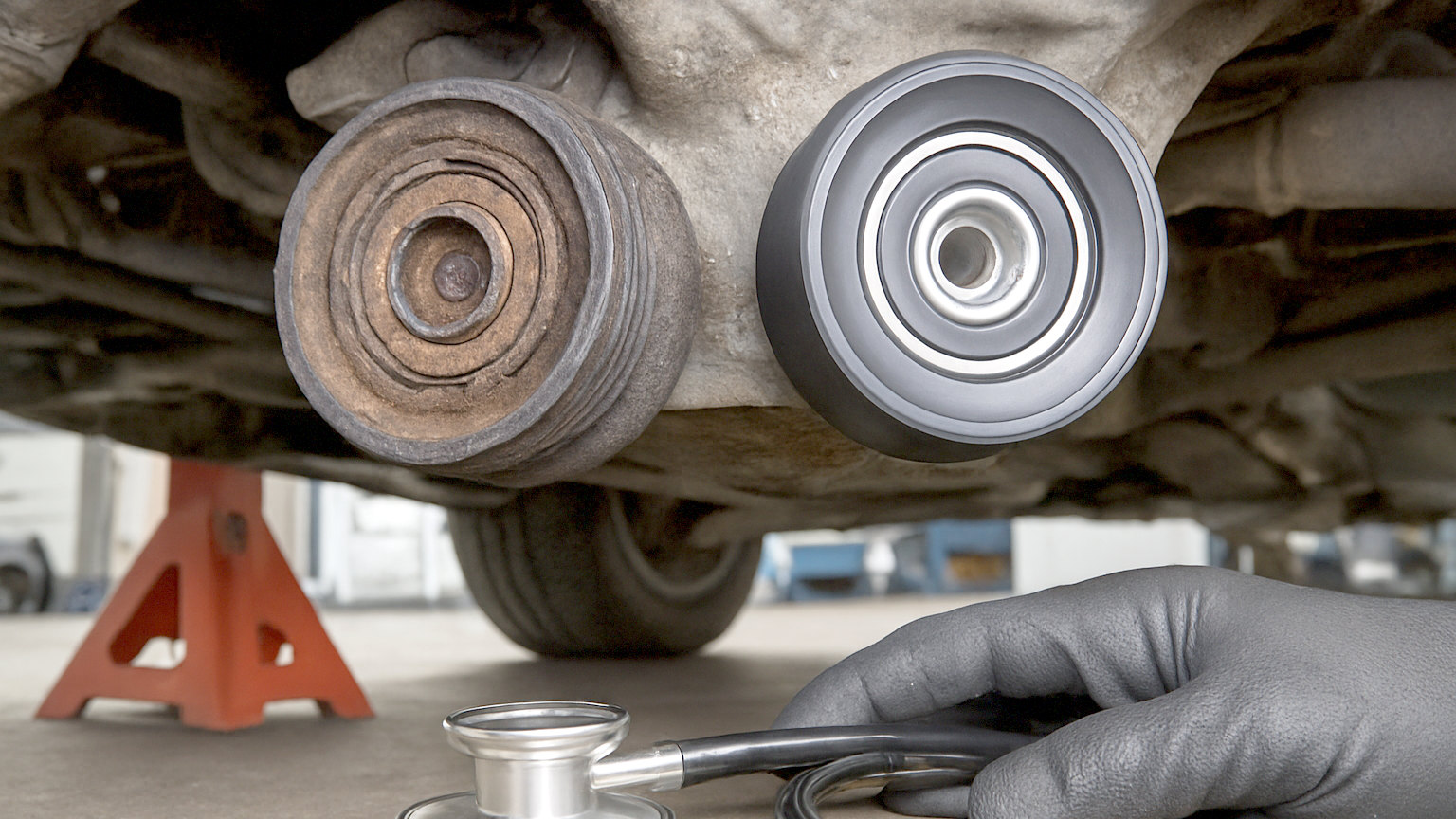
A mechanic stethoscope, which is a probe with a listening tube, allows a specific component to be isolated by touching its housing. A long screwdriver held against a casing with the handle to the ear does much the same job and is what many people use. Removing the auxiliary belt and running the engine briefly silences every belt driven accessory at once, which is a definitive test of whether the noise is on the belt or inside the engine. All of these need care around a running engine.
How should you describe it to a garage?
In terms of conditions rather than adjectives. Say that it starts about two seconds after a cold start and lasts fifteen seconds, that it rises with engine speed in neutral, that it worsens on full steering lock, and that it appeared three weeks ago. That description is worth far more than any attempt to spell out the sound. A short video with the phone microphone close to the engine is even better, and it captures a noise that may not repeat conveniently on the day of the appointment.
Where possible, offer to go out in the car with the mechanic so you can point out the noise as it happens. Ten minutes spent doing that regularly saves an hour of diagnostic labour, and it removes any risk of a repair being carried out on the wrong noise entirely.


