
There is something uniquely disheartening about a car that does nothing at all. No lights, no clicks, no dashboard, no interior lamp when the door opens. The good news is that total silence narrows the problem down more sharply than almost any other symptom, because it means power is not reaching the car rather than something inside the car having broken. That distinction usually points at connections, and connections are cheap.
Where does the check always start?
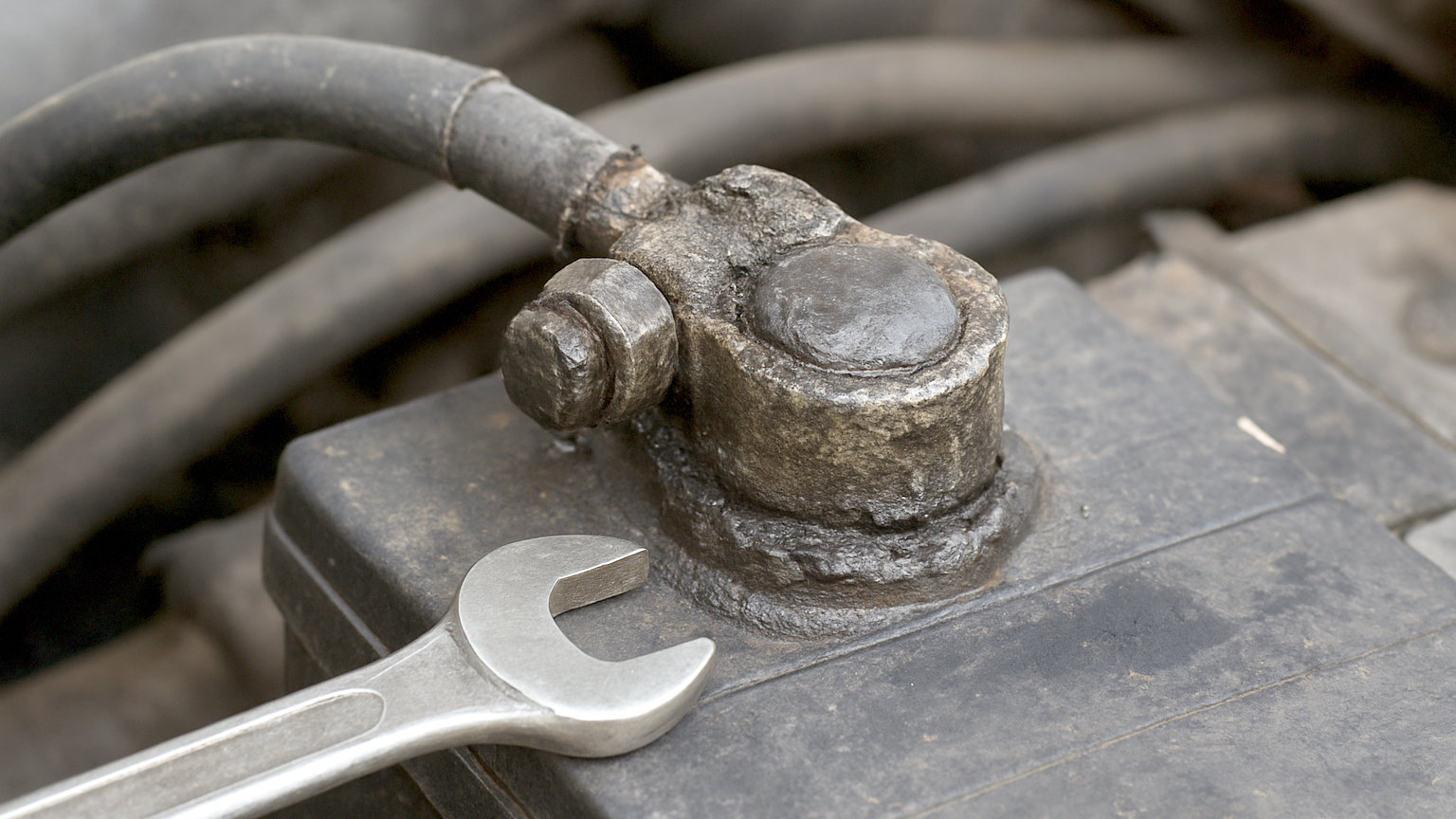
Open the bonnet and look at the battery terminals in daylight. You are looking for crusty white, blue or green deposits around the posts, for a clamp that can be twisted by hand, and for any lead that looks green under its insulation. Corrosion acts as an insulator, so a terminal that appears connected can be passing almost nothing, and this single fault accounts for an enormous share of cars that appear completely dead.
Cleaning them is straightforward as long as the order is right. Remove the negative clamp first and refit it last, clean posts and clamps back to bright metal with a wire brush, and tighten firmly enough that neither will rotate. If the car springs back to life afterwards, note that it may do the same again unless the underlying corrosion is treated, which usually means a smear of petroleum jelly over the finished joint.
Why do earth straps matter as much as the battery?
Electricity has to complete a circuit, and the return path runs from the engine and body back to the negative terminal through braided earth straps. These live in exposed positions, they corrode from the inside, and when one fails the symptoms are wildly inconsistent: everything dead one morning, everything fine the next, or lights that work while the starter does nothing. Follow the negative lead to where it bolts to the bodywork and the engine block and check both ends for corrosion and looseness.
Could a single fuse do this?
Most small fuses cannot kill an entire car, but the large main fuses in the engine bay fuse box certainly can. These handle the feed to the whole vehicle, and a failed one produces exactly this symptom. They are usually bolted rather than pushed in, and a blown one often shows a visible break through its window. Worth knowing before you spend on a battery that may be perfectly healthy.
How do you know if the battery is genuinely dead?
A battery that reads under about twelve volts at rest is discharged, and one that has been sitting below that for weeks has often been damaged permanently. Without a meter, the practical test is a jump start: if the car wakes up immediately on leads, the battery or its connections were the problem. If jump leads produce absolutely nothing, the fault is more likely a broken connection somewhere in the main circuit, because good leads should bypass a dead battery entirely.
What if it was fine yesterday?
A car that was perfectly normal the previous evening and completely dead in the morning has usually either been left with something switched on, or has a drain pulling current while parked. Boot lamps, glovebox lights and aftermarket accessories are common culprits, as are door switches that never quite register a closed door. If a new battery goes flat within a week or two, the battery was never the fault and a proper drain test is the next step.
When is this not a job for the driveway?
If the terminals are clean, the earths are sound and jump leads produce nothing, the fault lies deeper in the wiring or in a component that has failed short and is dragging the system down. That is a job for someone with a meter and a wiring diagram rather than trial and error. Anything involving heat, melted insulation or a smell of burning should be treated as urgent, and the battery disconnected until it has been inspected.


