
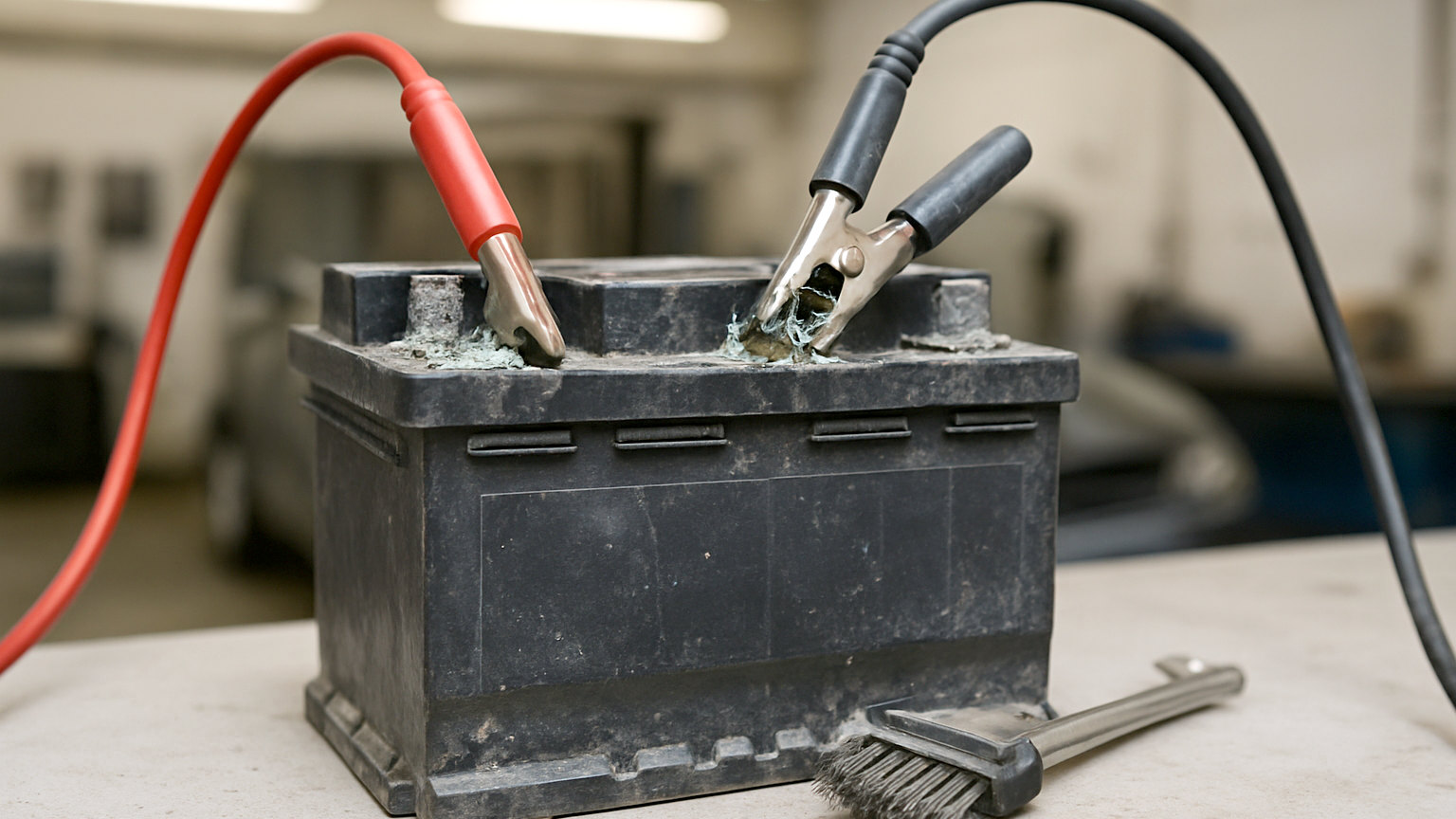
Jump starting is one of the few genuinely useful roadside skills, and it is also one of the easiest to get slightly wrong. The sequence exists for a reason: it minimises the chance of a spark near a battery that may be venting hydrogen, and it protects the electronics in both cars. Done in the right order it takes five minutes and is entirely safe, and it also doubles as a diagnostic that tells you where the fault lies.
What should you check before connecting anything?
Look at the flat battery first. If the casing is cracked, swollen or leaking, or if the battery is frozen solid in very cold weather, do not attempt a jump start at all, because a damaged battery can rupture. Make sure both cars are switched off, that they are not touching each other, and that the handbrakes are on and both are in neutral or park. Remove any loose clothing or jewellery that could catch on a moving part.
What is the correct order for the leads?
Connect the red lead to the positive terminal of the flat battery first, then the other red end to the positive terminal of the good battery. Next connect the black lead to the negative terminal of the good battery. The final black connection should go not to the flat battery but to a solid, unpainted metal point on the engine block or a dedicated earth post on the dead car, well away from the battery itself. That last connection is where a spark is most likely, and keeping it away from the battery is the entire point of the sequence.
How long should you leave it before trying?
Start the donor car and let it run for a few minutes at a fast idle. This puts some charge into the flat battery rather than asking the leads to carry the whole starting current on their own, which matters particularly with thin leads. Then try starting the dead car in bursts of no more than ten seconds. If it fires, leave both cars connected for a minute before disconnecting so the revived car is not asked to run entirely on its own immediately.
How do you disconnect properly?
In exact reverse order. Remove the black lead from the engine block of the revived car, then the black from the donor battery, then the red from the donor, then the red from the revived car. Keep the ends apart while you do it, and do not let a live clamp touch bodywork. Then drive the revived car for at least half an hour, because a five minute journey will leave the battery no better off than it was.
What if the car still will not start?
If nothing at all changes with good leads on a running donor car, the fault is not the battery, and further attempts will not help. Check that the clamps have bitten through any corrosion to clean metal, since deposits on the terminals can prevent the leads from doing anything useful. If the car cranks now but still will not fire, the battery was only part of the story and the problem lies in fuel, spark or a sensor.
Are booster packs a better option?
For most drivers, yes. A lithium jump pack removes the need for a second car entirely, fits in the boot, and the good ones include reverse polarity protection that prevents the single most damaging mistake. They need charging every few months to be any use, which is the one thing people forget. Whichever method you use, remember that a jump start is a rescue rather than a repair, and a battery that needed one should be tested rather than trusted. A battery that has gone flat once without explanation will usually do it again, and finding out why on your own driveway is far more convenient than discovering it in a car park after dark.


