
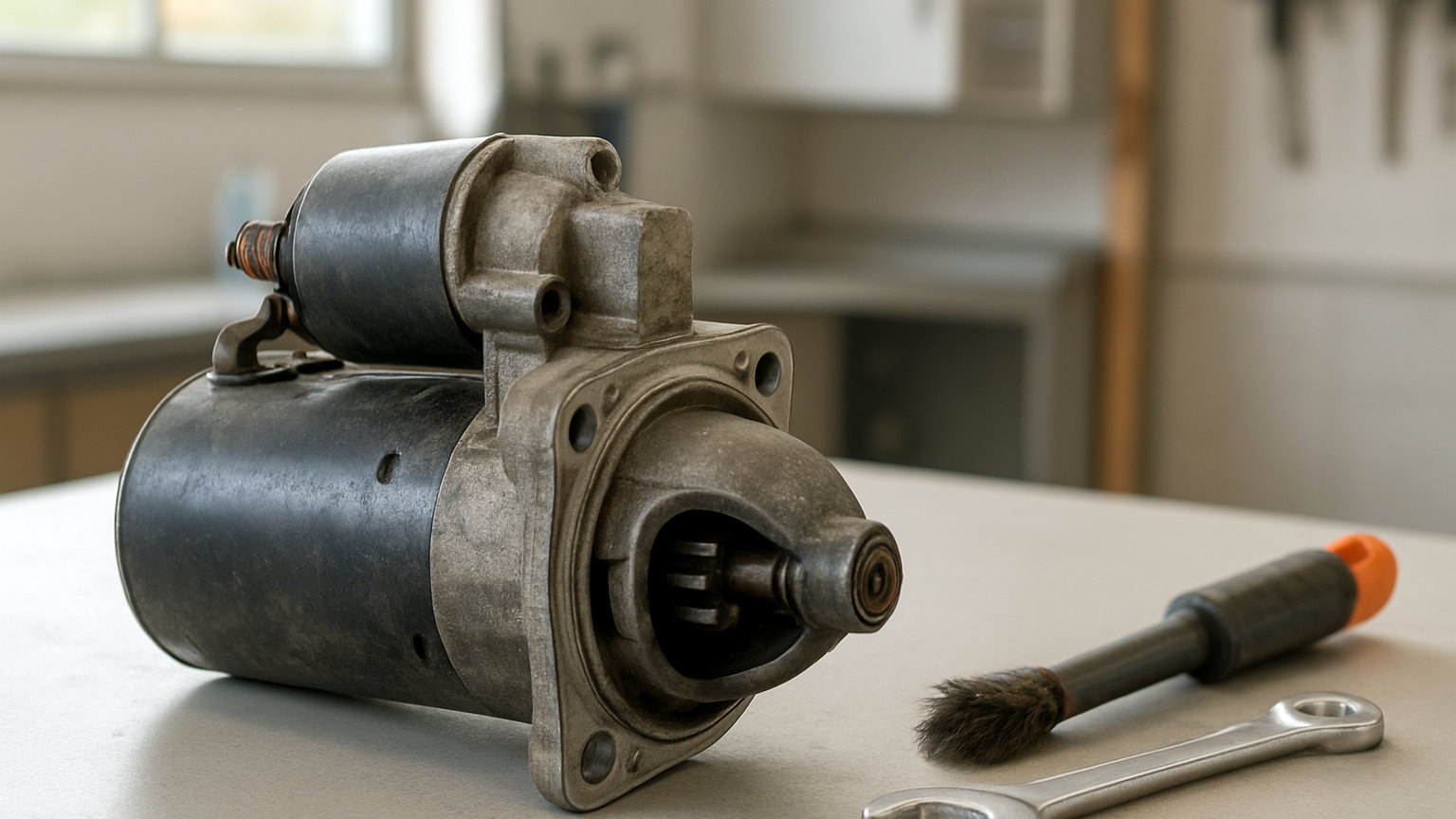
Clicking is the most misread no-start symptom there is, because two completely different faults both make a clicking noise and the repair bills sit at opposite ends of the scale. One of them you can often fix yourself in the time it takes to find a spanner. The other needs a starter motor. Telling them apart comes down to how many clicks you hear and what the dashboard lights do while it is happening.
Why do fast repeated clicks usually mean the battery?
When you turn the key, a small electromagnet called the solenoid pulls in and connects the battery to the starter motor. If the battery has enough charge to pull the solenoid in but not enough to spin the motor, voltage collapses the instant the motor tries to turn. The solenoid drops out, voltage recovers, it pulls in again, and the cycle repeats several times a second. That machine-gun rattle is the sound of a battery that is flat or failing, not a broken starter.
The dashboard confirms it. Watch the warning lights as you turn the key, and if they dim heavily or go out altogether in time with the clicking, the battery cannot hold voltage under load. A battery that does this while still lighting the interior lamp brightly is normal, because a bulb draws a couple of amps and a starter motor draws several hundred.
What does a single loud clunk point to?
One firm click, with dashboard lights that stay bright and steady, tells a different story. The solenoid has pulled in and stayed in, which means the battery is delivering current, but the starter motor itself has not turned. That usually means worn brushes inside the motor, a failed solenoid contact, or a jammed pinion gear. It can also mean the engine itself is seized, though that is rare and normally comes with a history of other warnings.
Where do bad earths and dirty terminals fit in?
A surprising number of clicking cars have perfectly good batteries and perfectly good starters. The current has to travel out of the battery, through the starter, and back to the battery through the engine and body earth straps, and any corroded or loose joint in that loop behaves exactly like a flat battery. Furry deposits on the terminals, a clamp that turns by hand, or an earth strap with a frayed end are all worth finding before you spend money.
Cleaning terminals properly means disconnecting the negative lead first, scrubbing the posts and clamps back to bright metal, refitting the positive first and the negative last, and tightening both so they cannot be twisted. It is a ten minute job and it resolves a genuinely large share of clicking no-starts.
How can you test which it is without equipment?
A jump start is a reasonable diagnostic in itself. If the car starts immediately on jump leads, the problem is the battery, its connections or the charging system, and the starter has just proved it works. If the car still clicks once with good leads on a running donor car, the starter circuit is the suspect. Another useful test is switching on the headlights and having someone watch them while you crank, because lights that collapse to nothing indicate a battery or connection problem rather than a motor problem.
Which repairs should you expect?
If the battery is at fault and it is more than five years old, replacing it is straightforward and usually the end of the story. If it is a young battery going flat repeatedly, the real fault is elsewhere, either a charging system that is not putting current back in or something drawing power while the car is parked. A failed starter motor is a bigger job on some cars than others, depending entirely on whether it sits somewhere reachable or is buried behind the exhaust manifold.
Is it safe to keep trying?
Not for long. Every attempt heats the starter windings, and a motor that is already struggling can be finished off by repeated cranking. It also drains a weak battery to a level where it may never fully recover. Diagnose before you crank again, because the clicking has already told you most of what you need to know.


