
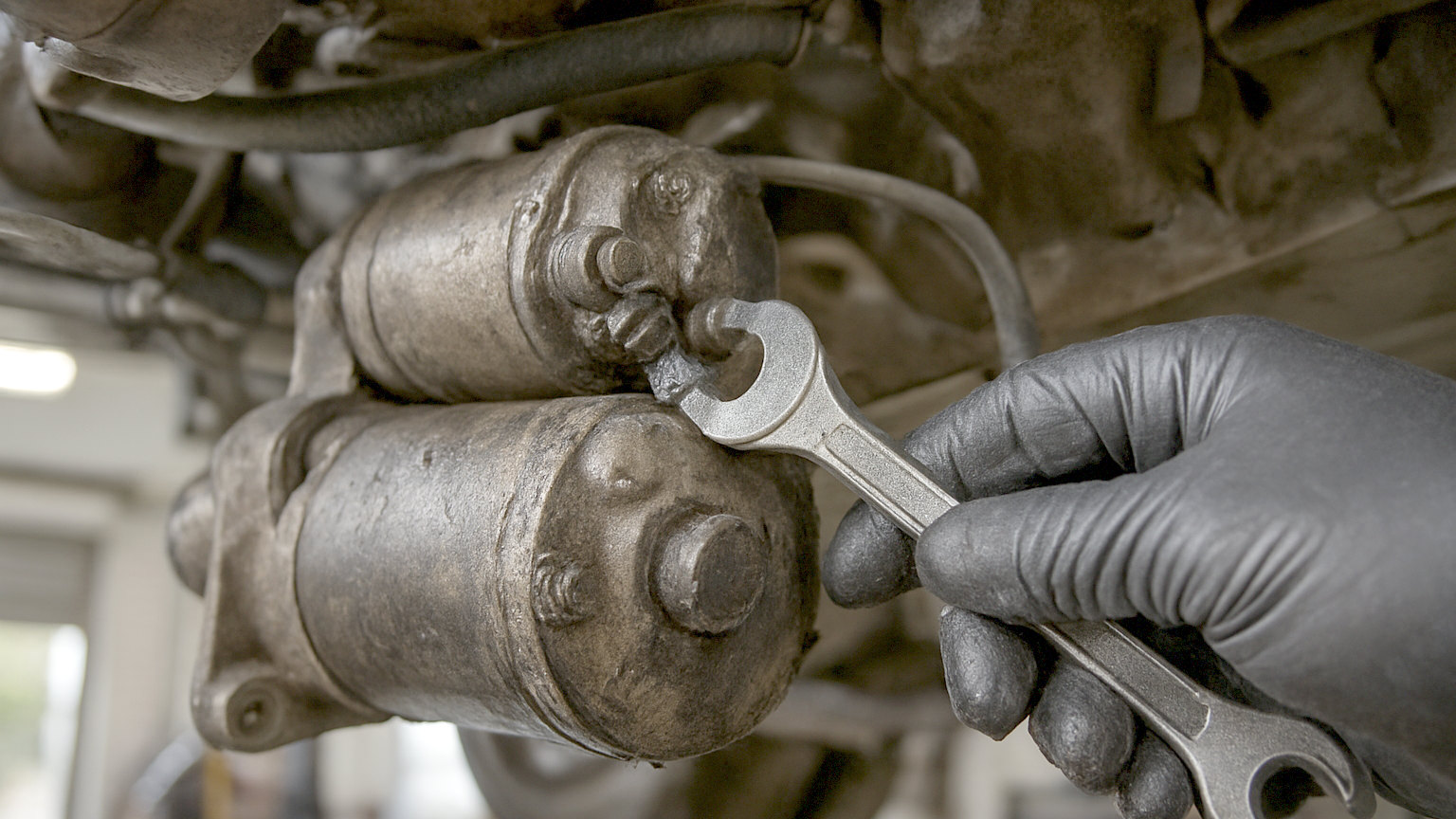
Battery and starter motor faults both end with a car sitting on the drive, but they cost very different amounts to put right and a wrong guess means paying twice. The tests that separate them are quick, need almost nothing, and rely mostly on watching what the electrics do while you turn the key. Getting this right before buying parts is the single most valuable thing you can do with a no-start.
What do the dashboard lights tell you?
Turn the key and watch the warning lights closely. If they are bright before you crank and then collapse or vanish as you turn the key further, the battery cannot hold voltage under load and is the prime suspect. If they stay steady and bright throughout while the car does nothing but click once, the battery is delivering current perfectly well and the fault is further down the line in the starter or its wiring.
Why is the headlight test still worth doing?
Switch the headlights on and have someone stand where they can see them while you crank. Lights that dim slightly are normal, because a starter draws an enormous current. Lights that fade to a dull orange or go out completely indicate a battery that has little left, or a connection that cannot pass the current required. Lights that do not flicker at all while the car clicks and refuses to turn suggest the current is not reaching the motor, which shifts suspicion to the starter or the heavy cable feeding it.
What does the noise tell you?
Rapid repeated clicking is the signature of insufficient voltage, which is a battery or connection issue. One heavy clunk with no rotation is a starter or solenoid signature. A grinding or whirring noise, where the motor is clearly spinning but the engine is not turning with it, points to a worn pinion or ring gear rather than either of the two main suspects, and is worth recognising because it needs a different repair.
How useful is a jump start as a test?
Very. Connecting good jump leads to a running donor car effectively supplies a fresh battery, so if the car fires up immediately the starter has just proved it works and the original battery or its charging system is the problem. If the car behaves in exactly the same way on leads, the battery has been eliminated and the starter circuit needs attention. This one test resolves most cases and costs nothing but a favour from a neighbour.
How old is the battery?
Age matters more than people expect. Most car batteries give three to five years of reliable service, a little less on cars doing short journeys, and the failure is often sudden rather than gradual. If yours is beyond five years old and the symptoms point that way, replacing it is reasonable. If it is under two years old and going flat repeatedly, the battery is a victim rather than a culprit, and the alternator or a parasitic drain is the real fault to chase.
What are the classic starter motor symptoms?
Starters usually give warning. Starting becomes intermittent, working every time except once a week, then once a day. Some cars start reliably when cold and refuse when the engine is hot, because heat increases resistance in worn windings. A starter that responds to a firm tap with a mallet, an old trick that genuinely works on worn brushes, has effectively diagnosed itself and should be replaced before it strands you somewhere less convenient.
What should you check before buying either part?
Clean and tighten the battery terminals and check both earth straps first, because a poor connection mimics both faults convincingly and costs nothing to correct. Many garages and parts shops will test a battery and charging system free of charge, which removes all guesswork. Spending twenty minutes on connections and a free test is a far better use of a morning than fitting a starter motor to a car that only needed its earth strap cleaning.


